The Status Quo is Not an Option Anymore

AI is moving from answering questions to taking action. That is why the status quo for market data contracts is no longer safe.
For years, the question was whether a team could find the right contract, clause, invoice, or renewal date when someone asked. Now the question is harder: can the business trust AI-powered workflows to act on licensed data when the governing rights, restrictions, and obligations are scattered across agreements, amendments, invoices, side letters, spreadsheets, and institutional memory?
Market data contracts have quietly become operational infrastructure, but most firms still manage them like static paperwork.
That was one of the central themes behind PostSig’s recent DKF 2026 presentation in Munich: Status Quo is not an Option. The point was not that market data teams have failed. Quite the opposite. For years, experienced teams have made imperfect systems work through judgment, memory, spreadsheets, and a lot of manual effort.
Contracts were stored somewhere. Invoices were checked somewhere else. Usage sat in another system. Renewal dates lived in spreadsheets. Vendor knowledge lived in people’s heads. And when something urgent came up, the team reconstructed the truth manually.
That model was never elegant. But for a long time, it was survivable.
Now the operating reality is changing.
The operating truth is fragmented
A market data contract is not just a legal document. It is the rulebook for what the firm bought, who can use it, how it can be used, what it should cost, when it renews, and what needs to be proven if a vendor, regulator, auditor, or internal stakeholder asks.
But after signing, the truth starts to move. There is the master agreement. Then the service order. Then the amendment. Then the invoice. Then a side letter. Then a usage change. Then an internal approval. Then a vendor conversation that everyone remembers, until the person who remembers it leaves.
This is the part organizations often underestimate. Contracts do not fail only because someone forgot to read them. They fail because the business keeps moving after signature, and the document trail does not stay connected by itself.
So the real question is not, “Where is the contract?” The better question is, “What governs us right now?”
Most firms cannot answer that quickly enough.
This is why the post-signature phase can no longer be treated as administrative cleanup. It is where cost, risk, rights, and leverage either stay under control or quietly drift. The problem is not that firms lack documents. The problem is that the documents no longer stay connected to the decisions they are supposed to govern.
The spreadsheet is not the villain
It is easy to blame spreadsheets. But the spreadsheet is usually not the enemy. The spreadsheet is the evidence.
It is evidence that the systems around the team do not understand enough. One system knows the vendor. Another knows the invoice. Another knows the document. Another knows the purchase order. Another knows usage. Another knows the renewal date. Each one is useful. None of them is sufficient.
So people fill the gap. They remember. They reconcile. They forward emails. They search shared drives. They ask legal. They ask procurement. They ask finance. They ask the person who used to manage that vendor three years ago.
That is not a workflow. That is institutional memory under pressure.
And it creates predictable drift: hidden cost leakage, audit exposure, missed renewal leverage, slow decisions, and key-person dependency.
The painful part is that these problems rarely look dramatic in the beginning. A renewal window closes. An invoice looks close enough. An entitlement stays active. A clause gap is discovered too late. A team buys something another team already has.
Nothing explodes. But value leaks.
The issue is not that teams are not trying hard enough. It is that the current operating model asks people to reconstruct contract truth after it has already fragmented. That may have been manageable when the pace of change was slower. It is increasingly risky in an environment where data, AI, regulation, and vendor economics are all moving faster.
AI makes this more urgent, not less
AI does not make contract governance optional. It makes weak governance more dangerous.
If a team wants to use licensed data in a GenAI workflow, the first question is not technical. It is contractual. Can we use this data for that purpose? Can we combine it with other data? Can we expose it to this tool? Can we use it for model training? Can we distribute the output? Can we prove our answer?
If the answer is spread across a master agreement, an amendment, an order form, an old email, and a vendor policy update, then the firm has a problem. Not an AI problem. An operating truth problem.
AI increases the number of decisions that depend on contract clarity. It increases the speed at which data moves. It increases the consequences of misunderstanding rights and restrictions. A usage clause that was once reviewed during procurement may now determine whether a dataset can be used in a model, workflow, product, or client-facing output.
The contract cannot sit downstream as an archive. It has to be connected to spend, usage, renewals, obligations, and decisions.
Market data teams do not need more dashboards. They need confidence.
There is a very experienced community around financial information, especially in Europe. People understand vendor complexity. They understand licensing nuance. They understand that a single word in a usage clause can matter. They understand that market data is not “just data.”
It is regulated, expensive, operationally embedded, and contractually constrained.
What these teams need is not another dashboard for the sake of another dashboard. They need confidence.
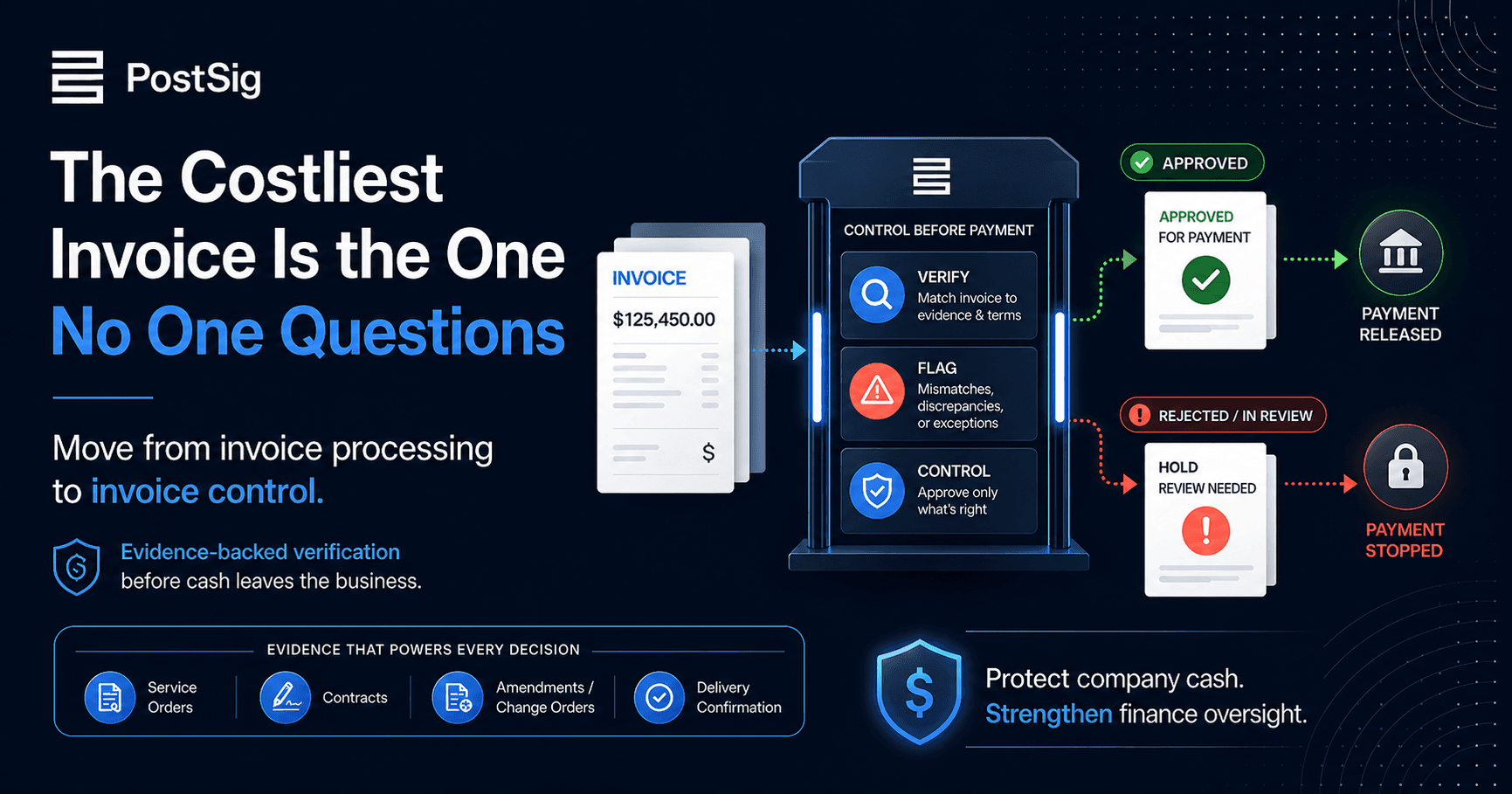
Confidence that the invoice matches the terms. Confidence that renewals are visible early enough to matter. Confidence that usage rights are understood before data is used. Confidence that audit evidence exists before the audit. Confidence that when someone asks “what are we allowed to do?” finding the answer does not become a three-week archaeology project.
That is a practical ambition. It is also a strategic one.
Market data experts still make the decisions. They still own the vendor relationships. They still know where nuance matters. But they should not have to rebuild the operating truth every time a decision needs to be made. The next operating model has to reduce reconstruction, preserve context, and give teams evidence they can act on.
The real job is connecting intent to execution
Every contract captures intent at a moment in time. The firm agreed to buy something, use something, pay something, restrict something, report something, renew something, or terminate something.
But execution does not stand still. People change. Systems change. Usage changes. Business priorities change. Vendors change. Regulations change. Documents change.
The gap between documented intent and real-world execution is where risk and waste accumulate.
That gap is now too important to leave to memory, scattered systems, and end-of-quarter cleanup. Firms need a way to understand what is currently in force, what has changed, and what action follows from it. Not only at renewal. Not only during an audit. Continuously.
This is the shift from contract storage to contract strategy.
A clause in isolation is data. A clause in context is leverage.
Where PostSig fits
At PostSig, we call this Contract Performance Management (CPM): keeping signed agreements connected to the spend, usage, renewals, obligations, and compliance requirements they govern after signature.
It is not about replacing CLM, ERP, CRM, procurement, or finance systems. Those systems matter. The missing layer is the intelligence that understands what the agreement, amendment, invoice, and operating signal mean together.
PostSig CPM was built for that post-signature reality. Powered by LineageAI™, it connects documents over time: master agreements, service orders, amendments, side letters, invoices, and obligations. The point is not just to extract fields. The point is to understand what is currently in force and what action follows from it.
For market data teams, that means a more current view of active agreements, amendments, renewal windows, pricing terms, usage rights, invoice discrepancies, utilization patterns, and compliance gaps. It helps teams move from reactive cleanup to continuous control.
The new operating model is already taking shape
If you run a market data function today, the question is not whether every workflow has to change overnight. The question is whether the firm has a serious answer to a basic problem: how do we ensure our contracts actually govern execution after signature?
The answer cannot be “we have the PDFs.” It cannot be “someone tracks that.” It cannot be “legal can check when needed.” By the time the question becomes urgent, the renewal window may have closed, the invoice may have been paid, the vendor audit may already be underway, or the data may already be used in a way that is hard to unwind.
This is especially important in market data because the contracts are unusually complex. They govern regulated information, high-value data feeds, changing entitlements, geographic restrictions, redistribution rights, audit requirements, and usage rules that can directly affect the firm’s cost structure and compliance posture.
A spreadsheet can track some of that. It cannot continuously understand all of it.
Methodical does not mean slow
There is still a practical way to start.
A firm does not need to boil the ocean. But it also should not confuse methodical with optional.
Start where the cost of uncertainty is highest. For some firms, that is renewals. For others, it is invoices. For others, it is entitlements, audit evidence, DORA readiness, or GenAI usage rights. The point is not to digitize everything for the sake of digitizing everything. The point is to identify where contract uncertainty is already creating cost, risk, or delay, and then put that area under active management.
A useful first question is simple: which important vendor questions still depend on a person who “just knows”?
Then look at the questions that follow. What did we buy? Who can use it? What are we paying? What renews in the next 120 days? What is the cancel-by date? Which rights changed in the latest amendment? Which invoices do not match the contract? Which obligations would be hard to prove in an audit? Which datasets are being evaluated, trialed, or used without enough context?
If those answers require too much manual work, the firm does not just have a documentation problem. It has an operating model problem.
The shift is already happening
Market data management is becoming more strategic because the consequences are bigger. Costs are higher. Data usage is more complex. Regulatory expectations are sharper. AI is creating new questions about rights, restrictions, and evidence.
The firms that adapt will not be the ones with the prettiest repositories. They will be the ones that can connect contract language to operating decisions quickly, accurately, and defensibly.
That is the shift from manual memory to a system of intelligence. It is the shift from finding documents to understanding what governs now.
This change is not five years away. It is already underway.
The status quo still feels familiar, but familiar is not the same as safe.