The Costliest Invoice Is the One No One Questions
Invoices are requests for payment. Finance teams need evidence before cash leaves the business.
Invoice reconciliation exists to protect the business, but in many organizations, it has become a race to keep the payment process moving. AP teams receive the invoice, route it for approval, and work through the queue. Finance needs confidence that the amount is right. Operations may need to confirm whether the product, service, subscription, or access was actually delivered. Legal may need to clarify which agreement or amendment applies.
The process is familiar. That familiarity is part of the problem.
The most expensive invoice in the business rarely looks suspicious. It often comes from a known vendor, in the expected format, on the usual cadence, with familiar line items and a recognizable approver. It moves forward because nothing appears obviously wrong.
That is how leakage hides. A line item may not match the service order. A billing frequency may not match the agreement. Pricing may reflect an outdated term. A service may be billed before it is delivered. A charge may sit just close enough to expectations that no one has time to question it.
For CFOs and finance leaders, this is not simply an AP efficiency problem. It is a control problem. Every invoice represents a request for company funds, and every request should be verified against what was authorized, what was agreed, and what was actually delivered before payment is released.
Once cash leaves the business, the leverage changes. Recovery takes time. Credits can be delayed. Vendors may dispute the issue. Internal teams may struggle to reconstruct what happened. Even when money is eventually recovered, the process consumes time and exposes a deeper issue: the business paid before it had confidence.
PostSig helps finance teams address that control gap before payment is made. By reconciling invoices against service orders, vendor agreements, amendments, and delivery status, PostSig gives teams an evidence-backed way to verify whether payment is justified before funds leave the business. PostSig’s Messaging House frames this as preventing value leakage by connecting documented intent to real-world execution, and its CPM application specifically includes invoice reconciliation against current negotiated pricing and terms.
The Invoice Is Not What Governs Payment
An invoice is not proof that payment is owed. It is a vendor’s request to be paid.
The decision to pay should be based on the record behind the invoice. That record includes the service order showing what was approved, the vendor agreement defining pricing and scope, any amendments or schedules that changed the terms, and confirmation that the goods, services, subscription, or access were actually delivered.
This distinction matters because an invoice can look correct and still be wrong. It may include outdated pricing. It may bill monthly when the agreement says quarterly. It may include unauthorized line items. It may charge for services that have not yet been delivered. It may rely on a prior version of the terms that were later changed.
The invoice starts the payment conversation. The governing record determines whether payment should move forward.
For CFOs, This Is Fiduciary Discipline
CFOs are responsible for protecting company funds, maintaining financial controls, and ensuring that payments are defensible. That means invoice review cannot stop at routing, approval, or familiarity with the vendor.
A workflow can send the invoice to the right person. It can capture an approval. It can create a process record. But the existence of a routed and approved invoice does not, by itself, prove that the invoice matches what was authorized, agreed, and delivered.
That is where invoice leakage becomes a financial control issue.
If finance pays an unsupported invoice, the damage is not limited to the overpayment. The business may lose negotiating leverage with the vendor, weaken audit defensibility, distort forecasts, and normalize spend that should have been challenged. In high-volume environments, small mismatches can compound into a meaningful loss of control.
The risk is not that AP or finance teams are careless. They often work under pressure with incomplete evidence, fragmented systems, and limited time to reconstruct the full record for each invoice.
This is not a people problem. It is a control gap.
AP Systems Move Invoices. PostSig Gives Finance Evidence-Backed Verification.
ERP and AP systems are essential. They route invoices, manage approvals, trigger payments, and preserve process history. Those functions matter.
But routing is not the same as validation.
A well-routed invoice can still be wrong if it is not checked against the documents and evidence that determine whether payment is justified. That is where PostSig fits.
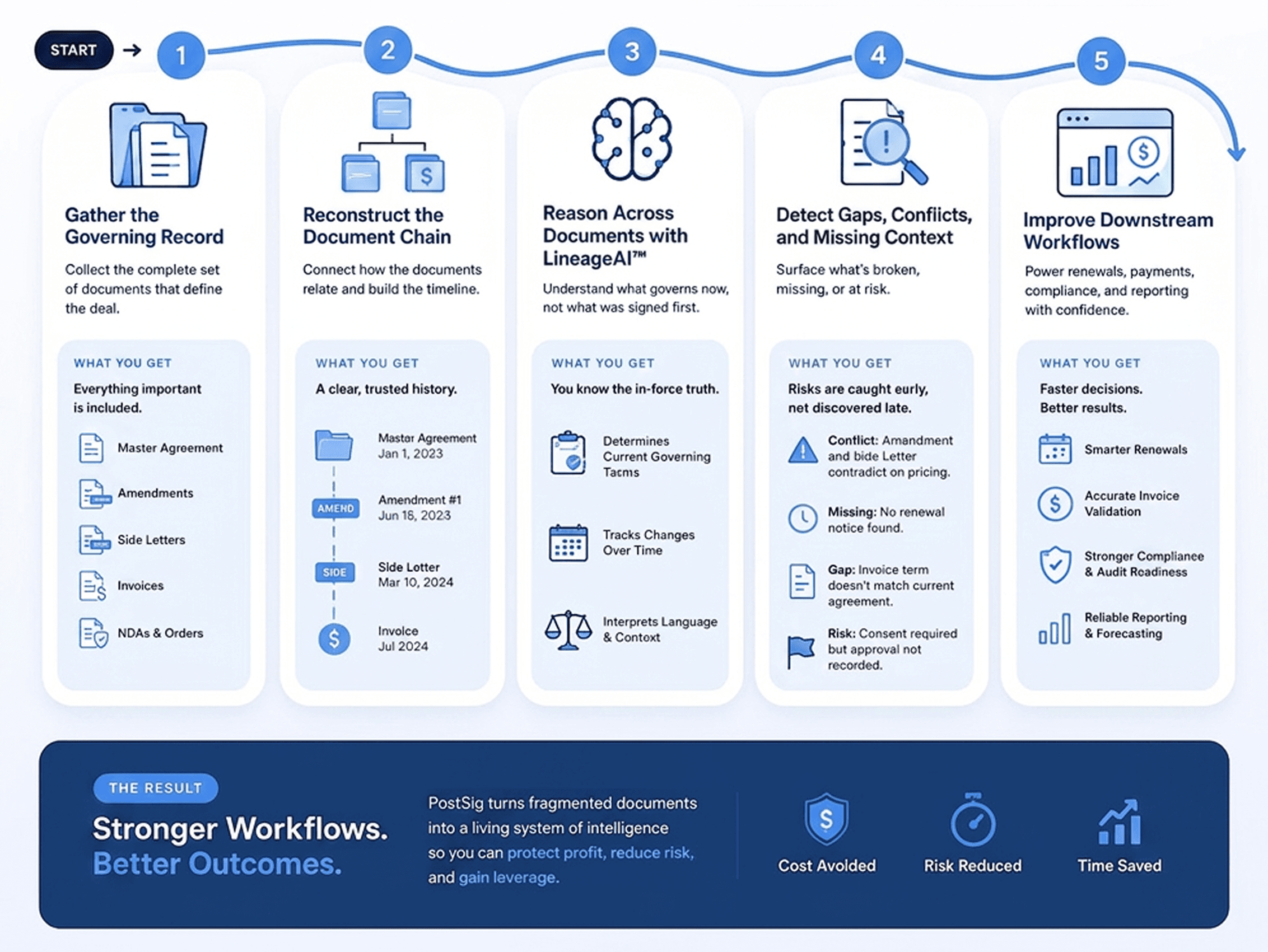
PostSig operates alongside existing AP, ERP, and contract systems as a post-signature intelligence layer. It connects the invoice to the contract, service order, amendments, pricing terms, billing frequency, and delivery status that govern whether the payment request is valid.
That gives finance evidence-backed verification before cash leaves the business. Instead of relying on a rushed approval or a manual hunt through PDFs, emails, and spreadsheets, teams can see what was authorized, what was agreed, what changed, and what was delivered.
This matters because commercial terms do not stay static. Pricing changes. Amendments adjust scope. Service orders define what was actually approved. Delivery may lag billing. When those pieces are scattered across systems, finance is forced to reconstruct the answer manually, often after the invoice is already in motion.
PostSig brings the governing record into the invoice review process, enabling teams to verify payment requests before they become payments.
How PostSig Creates Control Before Payment
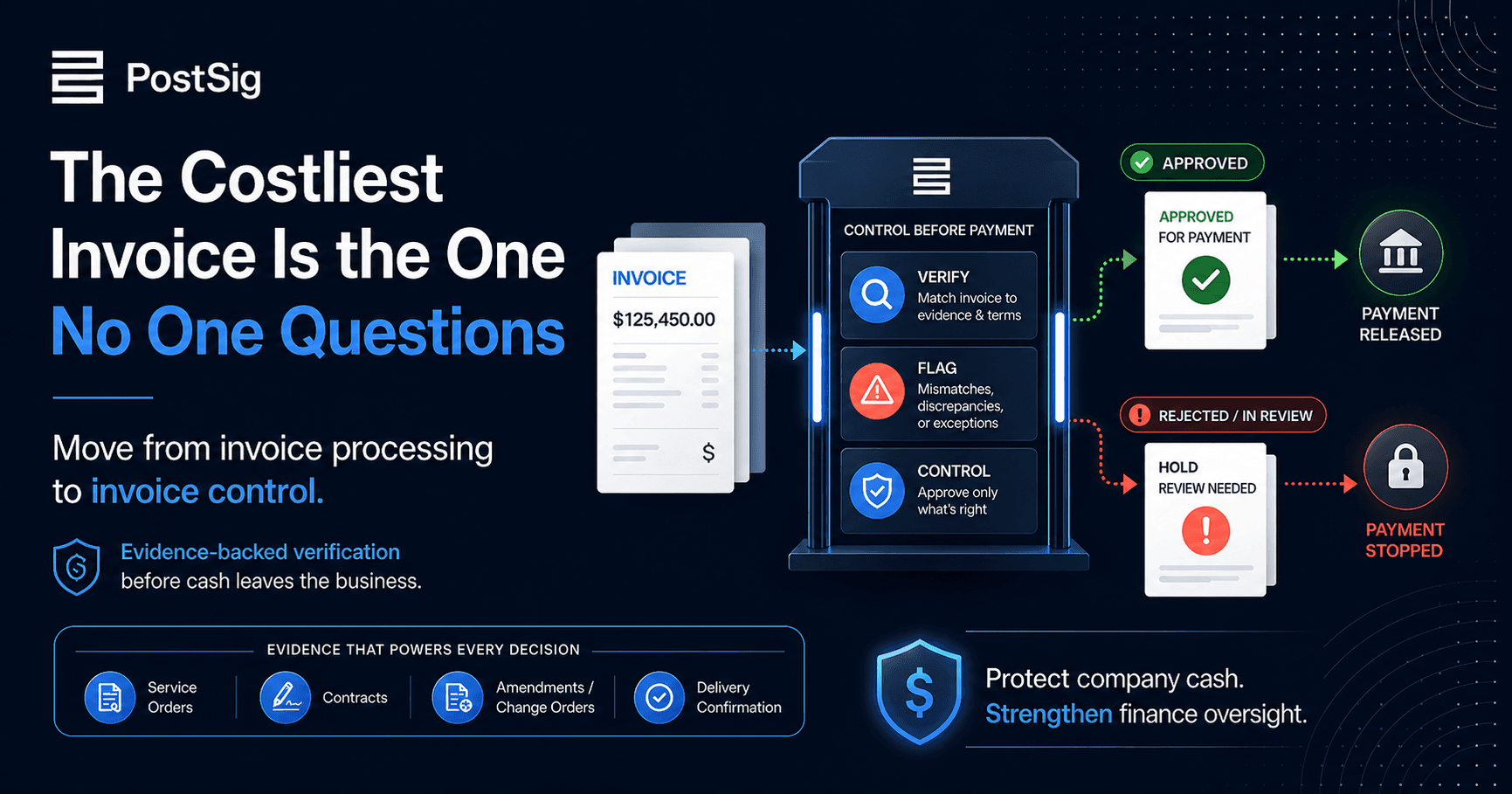
PostSig gives finance and AP teams a structured way to verify invoices before they move downstream for payment.
Invoices can be sent in bulk or auto-routed to PostSig via email. From there, PostSig reconciles the invoice against the records that determine whether payment is justified: the service order, the vendor agreement, related amendments, pricing terms, billing frequency, and delivery status.
The first step is matching the invoice to what was approved. PostSig checks whether the billed products, services, subscriptions, or access rights connect back to the relevant service order or business order. If a charge lacks an approved basis, it can be flagged before it is blended into normal processing.
Next, PostSig checks the invoice against the governing agreement. That means comparing the billed amount, cadence, scope, payment terms, user counts, and other commercial terms against the contract and any related amendments. This is where hidden discrepancies often surface: outdated pricing, unsupported increases, wrong billing frequency, or charges tied to terms that no longer apply. PostSig’s invoice discrepancy reporting is described as comparing uploaded invoices to contracted pricing and billing terms, then flagging mismatches in amounts, frequencies, or unauthorized line items without manual reconciliation.
PostSig also helps teams identify invoices or line items that appear rogue, duplicated, incomplete, or out of scope. Instead of relying on AP to manually search across PDFs, spreadsheets, and email threads, finance gets a clearer view of what does and does not align with the governing record.
When business confirmation is required, PostSig supports a review before payment proceeds. Teams validate whether the vendor delivered the product, provisioned access, provided the service, or fulfilled their obligations. That matters because a charge can match the agreement and still not be payable if delivery has not happened.
From there, teams can assign a clear status, such as approved, in review, rejected, or incomplete. Those outcomes can then route back into downstream AP workflows, so payment decisions are based on evidence rather than assumption.
The result is a cleaner control loop: intake, reconcile, flag discrepancies, validate delivery, assign status, and send the outcome back to AP.
PostSig does not replace the systems finance already uses to process invoices. It strengthens the control point before those systems release cash.
Move From Invoice Processing to Invoice Control
Invoice processing keeps payments moving. Invoice control keeps the business protected.
That is the difference CFOs should care about.
PostSig gives finance teams an evidence-backed control point before funds leave the business. By reconciling invoices against service orders, vendor agreements, amendments, pricing terms, billing frequency, and delivery status, PostSig helps teams verify what is owed, stop what is not, and make payment decisions with confidence.
The outcome is not just faster reconciliation. It is stronger control over cash, fewer unsupported payments, better vendor leverage, and less time spent recovering money that should never have left.