In Contract Intelligence, Data Quality Is the Product

The AI layer gets the attention. The ingestion layer determines whether any of it works.
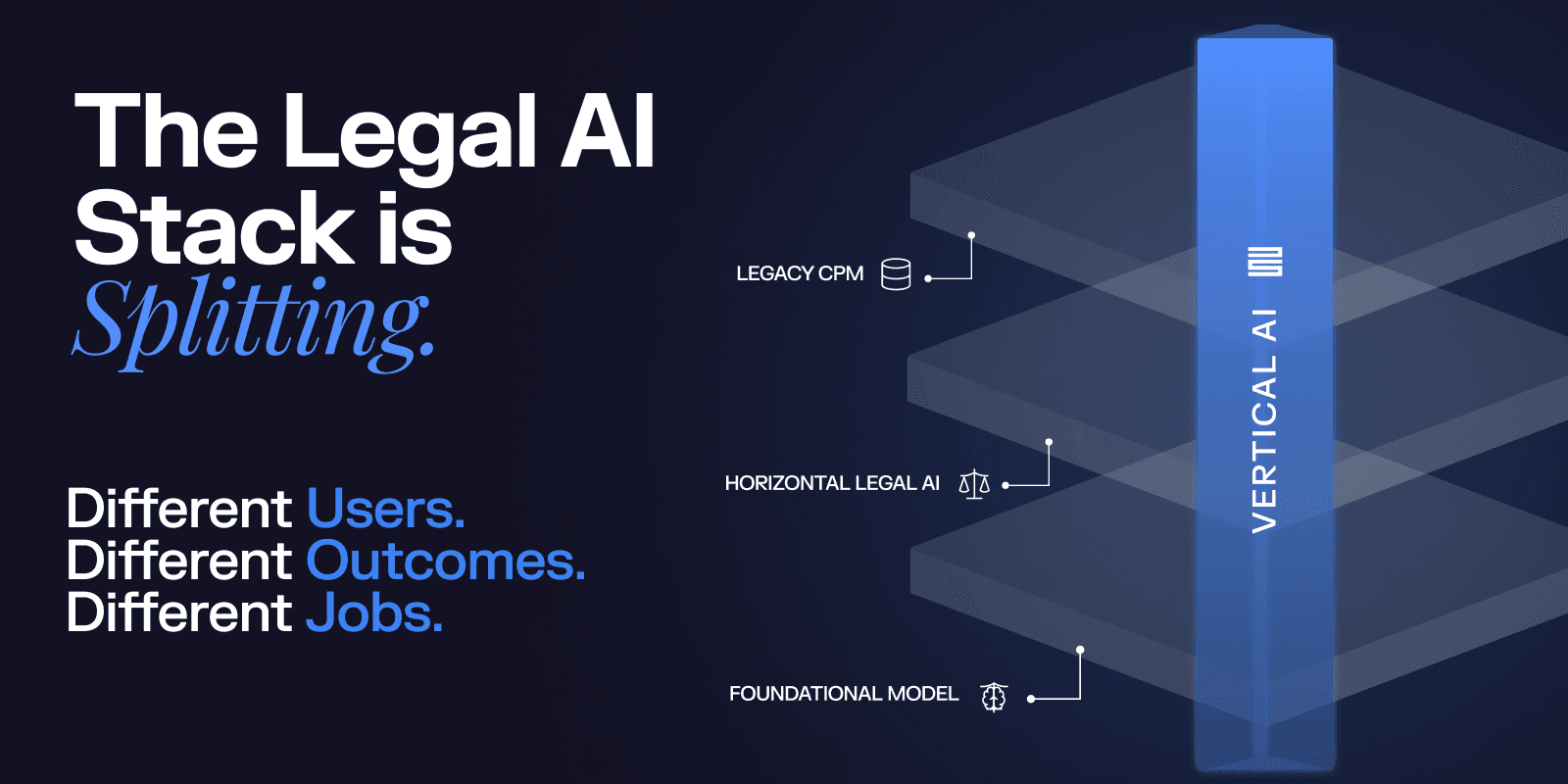
It seems like there is a real divide starting to emerge in this market.
One group is made up of legacy CLM, document management, and service-led platforms now moving quickly to market AI features, workflows, and natural language interfaces. But many of those offerings still depend on older extraction models, manual review, and data foundations that were never designed to support trustworthy automation at scale.
The other group is AI-native. In these systems, extraction quality, document lineage, and source-level trust are not add-ons. They are the core architecture.
That distinction will matter more and more over the next few years.
Because the real question is not whether a vendor can demo an AI feature. It is whether the underlying data can carry the weight of the workflow built on top of it.
That matters because bad ingestion data does not stay at the ingestion layer. It moves through the system. It affects workflows, reporting, recommendations, and decisions.
For buyers, this is not just a technical issue. It is an economic one.
If the data foundation is weak, the software does not simply become less accurate. It becomes harder to automate, harder to trust, and less valuable over time.
We have seen this firsthand across both sides of our business.
On the investor rights side, we enabled customers to ingest files from legacy services built on manual, human-first extraction processes as part of onboarding to PostSig IRI. At first, that seemed like the obvious bridge. In practice, something more revealing happened. Customers started trusting the data generated directly from our document extraction process more than the imported legacy records. Once they compared those imported fields against the source documents, it became clear that the prior data sets contained more inconsistencies and errors than expected.
We are seeing a similar pattern on the contract performance side.
That matters even more now because more vendors are beginning to promise AI on top of contract data. But if the extraction layer is inconsistent, incomplete, or error-prone, the intelligence built on top of it becomes compromised and unreliable from the start.
Ingestion is not a setup step. It is not a back-office detail. It is the foundation of the product.
A dashboard built on shaky data is still shaky.
A workflow built on shaky data is still shaky.
An AI recommendation built on shaky data is still shaky.
A lot of people still think about data quality in percentage terms. If 95% of the extracted data is correct, they assume that should be good enough.
Usually, it is not. One wrong data point in a deal document can quickly cascade into real consequences: financial loss, compliance and legal risk, cap table confusion, broken investor rights, and LP reporting errors.
Because the real problem is not that 5% is wrong. The real problem is that you do not know which 5%.
That uncertainty compounds quickly.
A wrong renewal date can lead to a missed notice window.
A wrong pricing term can distort invoice review.
A missed amendment relationship can change the meaning of the governing agreement.
A wrong rights extraction can affect governance, ownership visibility, or reporting.
Once that happens a few times, behavior changes fast. Teams start double-checking the system, keeping parallel spreadsheets, and hesitating to automate. That is the trust tax: the hidden cost of unreliable outputs. Every questionable result pulls people back into manual review, duplicate tracking, and slower decisions. At that point, the economics start to break down.
This is also where the market should be more critical of labor-heavy extraction models.
In many parts of this category, what gets presented as structured contract data still depends on manual extraction and review, often in offshore markets, with revolving teams, limited oversight, long turnaround times, and slow extraction cycles. That model is inherently less scalable and less reliable. When volume rises, more people need to be added. New hires are slower, less accurate, and less consistent until they ramp. The quality problem does not improve with scale, it often gets worse.
There is also a security and governance issue here that deserves more attention. Buyers should think carefully about what it means for their most private documents and data to sit on machines and in workflows managed by third-party teams they do not directly oversee. Even when contractual safeguards exist, the operating model itself introduces risk.
A strong AI-native extraction architecture behaves very differently. As the system processes more documents, sees more edge cases, and refines more patterns, it should become faster, more accurate, and more efficient over time. Humans still matter, but their role should be exception handling, targeted review, and oversight, not serving as the primary engine behind the record.
To make this more concrete, consider three simple scenarios.
Scenario 1: Contract Performance Management
Imagine a buy-side firm managing 200 vendors and $25 million in annual third-party spend through a contract intelligence platform. At a 5% material error rate, roughly 10 vendor records are wrong in ways that matter, renewal dates, pricing terms, notice periods, amendment relationships, or user entitlements.
If each bad record creates just 4 hours of internal cleanup, that is 40 hours, or $6,000 at a blended cost of $150 per hour.
Now, assume only a handful of those errors create financial consequences:
- 2 pricing mistakes cause $40,000 in overcharges
- 2 renewal errors reduce leverage by $60,000
- 1 entitlement error creates $25,000 in avoidable spend
That is $125,000 in downstream impact.
Then add the trust tax. If the team spends just 5 extra hours per week manually verifying records because they no longer trust the system, that adds another $39,000 per year.
Illustrative annual economic drift : $170,000
Scenario 2: Investor Rights Intelligence
The stakes are higher on the investor rights side. Consider a venture firm using a rights intelligence platform across 120 portfolio companies. At a 5% material error rate, only 6 company records are wrong, but those six may involve liquidation preferences, pro rata rights, board rights, protective provisions, or side letter terms.
If each issue creates 7 hours of cleanup across legal, finance, and investment staff, that is 42 hours, or $8,400 at $200 per hour.
Now assume:
- 1 rights error distorts an important exit or governance analysis, costing $50,000
- 2 others trigger extra legal and internal review costing $30,000
- 1 reporting error creates another $20,000 of rework
That is $100,000 in downstream cost.
If the team then spends just 4 extra hours per week rechecking documents because trust has eroded, that adds $41,600 per year.
Illustrative annual economic drag: $150,000
The stakes compound further at deal time. A rights error surfacing during a follow-on round, acquisition process, or diligence review can delay a close, reopen negotiated terms, or erode founder and co-investor trust at exactly the wrong moment.
The issue is not six wrong records. It is that six wrong records are enough to make the whole system harder to trust.
Scenario 3: Invoice Reconciliation
Invoice reconciliation makes the dependency most visible. Take a firm processing 1,000 invoices per year against vendor contracts in a platform that promises automated invoice reconciliation.
That workflow only works if the underlying pricing terms, service periods, user counts, renewal logic, and amendments were ingested correctly.
If weak extraction affects contract records tied to just 50 invoices per year, the economics turn quickly.
Assume:
- 10 invoices are overbilled by $7,500 each, creating $75,000 in missed savings
- 15 invoices are falsely flagged, creating review work
- 25 more now need manual validation because the team no longer trusts the workflow
That extra review time adds about $5,156 in labor. If finance then spends just 2 extra hours per week spot-checking the system, that adds another $13,000 per year.
Illustrative annual economic drag: $93,156
And that is before counting the bigger issue: once finance stops trusting the output, the value proposition behind automated invoice reconciliation starts to weaken.
Three different use cases. The same failure mode.
That is the hidden cost of bad ingestion.
The hidden cost of bad ingestion shows up as labor, as bad decisions, and most importantly, as eroded trust.
Trust is what determines whether a system becomes the operating layer for a business process. Once trust falls below a certain threshold, adoption slows, expansion stalls, and downstream AI starts to look much less useful in day-to-day operations.
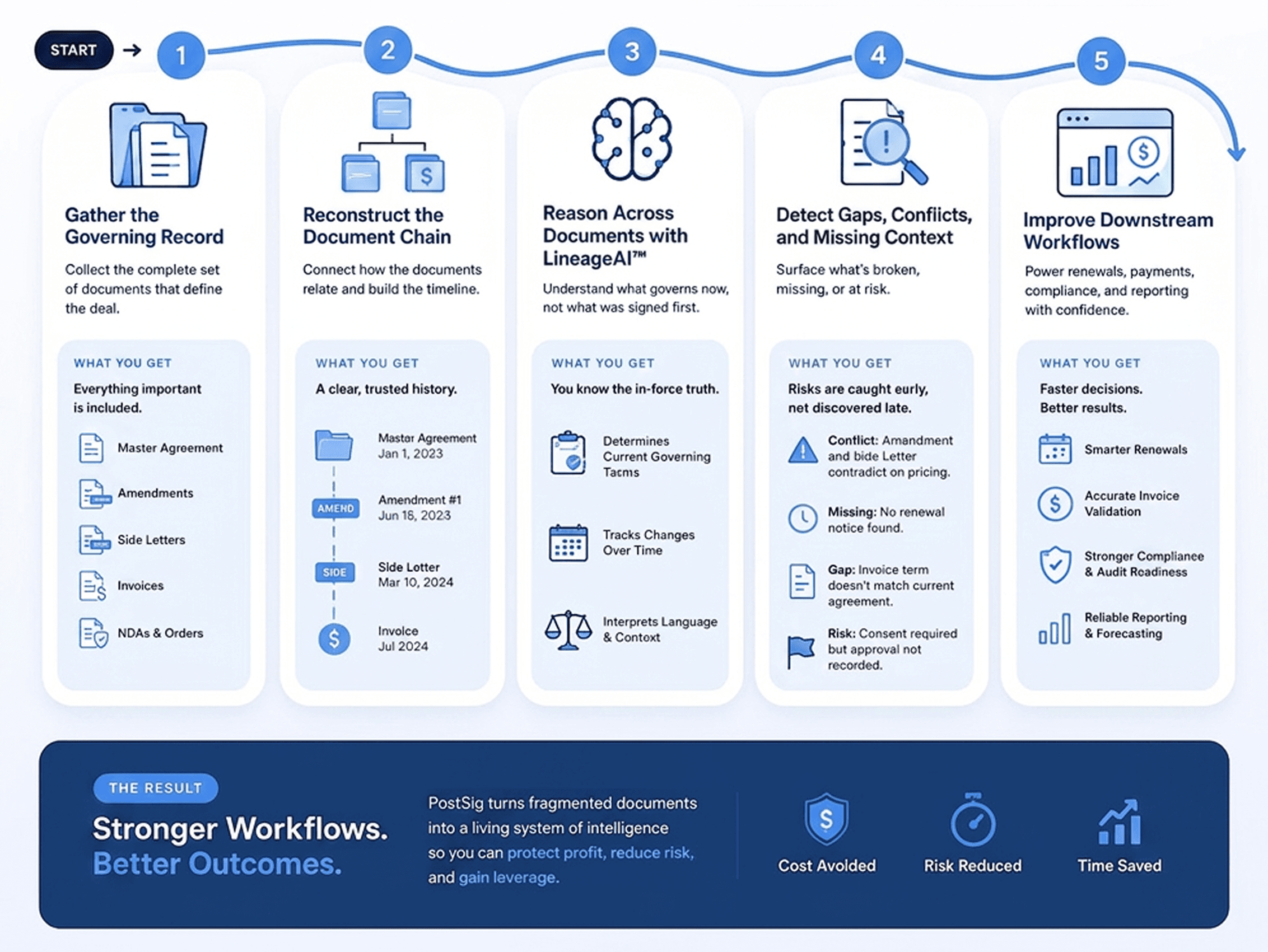
The winning systems in this category will combine machine extraction, source-level traceability, document lineage, confidence-aware review, and explicit handling of amendments, side letters, schedules, and related documents. They will produce a record that is trustworthy enough to support real decisions, real workflows, and real automation.
The future of this market is not just better search or better summaries. It is execution: knowing what governs, knowing what changed, knowing what action needs to happen next, and trusting the answer enough to run a process on top of it.
In contract and document intelligence, the winners will not be the vendors with the longest history of servicing documents. They will be the ones whose data foundation is strong enough to support real decisions, real workflows, and real automation at scale.