The Legal AI Stack Is Splitting, Not Converging
The legal AI conversation often gets reduced to a simple question: who is going to win?
That is probably the wrong question.
A better one is this: what part of the stack are you actually talking about?
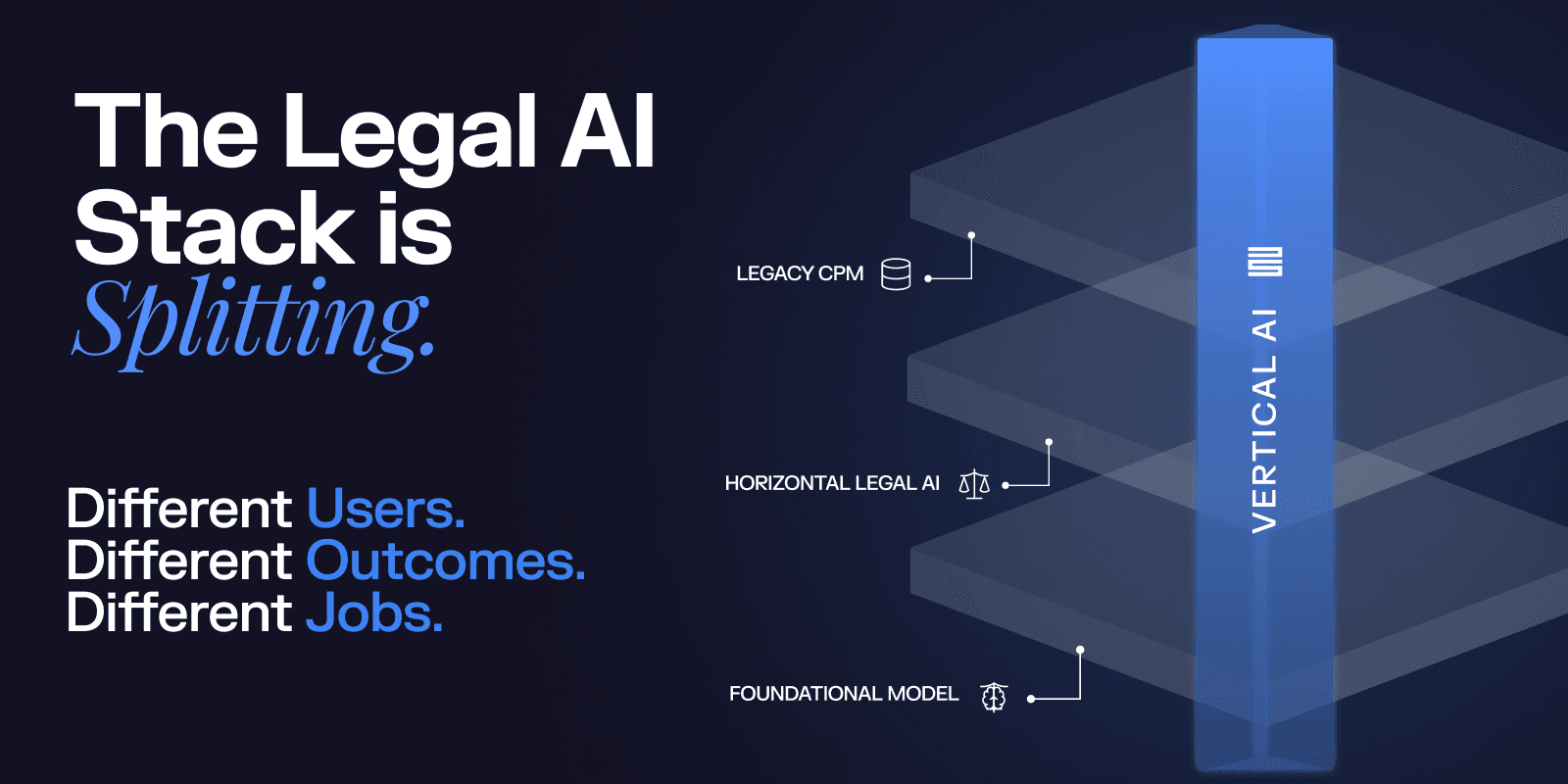
Because the market is not moving toward one monolithic category called legal AI. It is splitting into layers.
That fragmentation is already visible in how the market itself is being mapped. In its March 2026 transactional market map, The LegalTech Fund highlights more than 100 early-stage companies, roughly $827M in collective funding, more than 4,000 professionals, and a category structure that already spans areas like Agentic Due Diligence, Transaction Management & Closing, Document Automation & Drafting, Regulatory & Specialized Support, Intelligent Data Rooms, and Operations. That is not a market converging around one product shape. It is a market expanding into multiple layers, buyers, and systems.
At one end are foundational models like ChatGPT and Claude. On top of them sit horizontal legal AI companies like Harvey and Legora, to name just a few, and there has clearly been a real run on this category. Alongside them are legacy CLM platforms that still own much of the contract process. And increasingly, another category is taking shape: verticalized AI, built not for the legal team’s workflow, but for the legal-adjacent operational teams across the business that need to determine what happens next based on the company’s ultimate source of truth, the signed documents.
That distinction matters because buyers still talk about these products as if they are interchangeable. In many cases, they are not. They serve different users, solve different problems, and create value in very different ways.
Start with the bottom layer: foundational models
ChatGPT and Claude are best understood as broad-purpose AI work platforms.
Plain and simple, they are general systems that can reason across text, summarize, compare, draft, analyze files, and support a very wide range of tasks. That makes them incredibly useful across almost every function inside a company, including legal. ChatGPT and Claude also now include features like project-based context and memory, which make them much more useful for ongoing work than the first generation of chat interfaces.
But they are still broad by design. They are not legal products in the full sense. They do not inherently come with legal workflows, contract lifecycle controls, or a domain-specific operating model.
And this is an important distinction: even when memory and project features exist, the foundational model layer is still not, by itself, a durable system of record or an operational workflow state. Persistent context, business logic, permissions, evidence trails, and process continuity all have to be deliberately added around the model. A model may be able to understand a document in the moment. That is not the same as being the system that remembers what that document needs to do over time.
That is what makes foundational models so powerful, and also what creates the opening above them.
They provide intelligence. But they do not, on their own, define the exact workflow or business system in which that intelligence should operate.
Next comes horizontal legal AI
This is where Harvey, Legora, and a growing set of peers fit.
The important point here is not how they market themselves. The important point is who the primary user is: the lawyer.
These products take the raw capabilities of foundation models and package them into something much more useful for legal work. That is true quite literally in Harvey’s case, given that OpenAI Startup Fund was an early investor. The broader point is the important one: even the model ecosystem itself recognized that there was room, and value, in building a dedicated legal application layer on top.
Review, research, drafting, comparison, redlining, knowledge retrieval, and collaboration all become much more usable when the product is built around legal workflows rather than a general-purpose model interface.
That is what makes horizontal legal AI compelling. It narrows the gap between general-purpose intelligence and legal-specific productivity. It helps lawyers work faster and often better.
Still, the center of gravity remains legal productivity.
That is a major advance, but it is not the same as owning a business process downstream from the legal answer. A legal team may get to a better answer faster, but the system itself is often not built to manage the full operational chain that follows.
That is where the next categories begin to matter.
Then there is legacy CLM
Legacy CLM remains a distinct category because its job has always been different.
Platforms like Agiloft, Ironclad, Icertis, DocuSign CLM, and others were built to manage the contract lifecycle itself: request, drafting, negotiation, approvals, signature, repository, renewals, and termination. Their strengths are governance, workflow, auditability, and system-of-record control.
Even as AI becomes more capable, companies still need structured process management and a place where contract records live. That is why CLM does not disappear just because legal AI gets better. It plays a different role.
But the limitation is architectural as much as conceptual.
Many CLMs were not born as intelligence systems. They were born as process systems. Their DNA is workflow, administration, storage, approvals, and control. In practice, many of them have as much in common with project management software as they do with intelligence software: routing tasks, managing handoffs, tracking status, enforcing steps, and making sure the process moves forward.
That is useful. In many organizations, it is necessary.
But it also explains why AI can feel bolted on rather than native. When the system is built first to shepherd a process, rather than to reason from the document itself, the result is often a better-managed workflow, not necessarily a smarter operating system built on the truth inside the signed agreement.
That does not make CLM irrelevant. It simply means that many CLMs are strongest at managing the contract process to the point of signature, not necessarily at reasoning through the full set of financial, commercial, and operational implications that emerge after signature.
The newest layer is verticalized AI
This is where the market gets especially interesting, and where the framing usually goes wrong.
Vertical AI is not trying to win by being a better version of horizontal legal AI. It is not built for the same user and does not solve the same problem.
Horizontal legal AI is built first for lawyers and legal teams.
Vertical AI is built for the business-side functions adjacent to legal: operations, procurement, finance, compliance, engineering, reporting, and other teams that need to answer a much more operational question:
What happens next, now that this document is signed?
That is the real divide.
In this world, the contract is not just a legal document. It is the absolute layer of truth for what the business is allowed to do, required to do, paying for, exposed to, and accountable for.
That is why vertical AI is best understood as a system of intelligence for the operating side of the business.
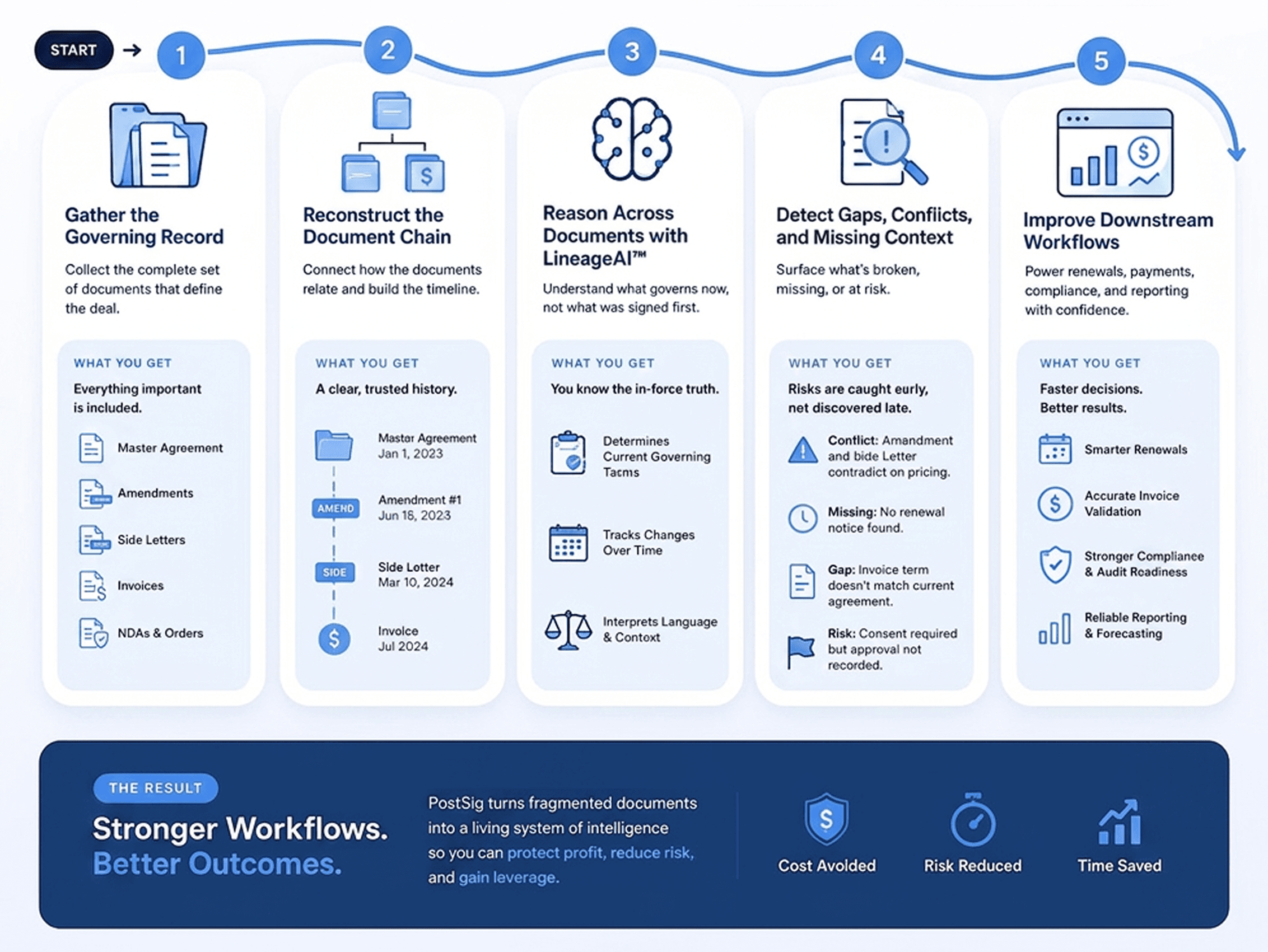
And more importantly, it puts signed documents to work.
A single agreement should not just sit in a repository waiting to be searched. It should serve multiple jobs across the business. The same document can have a SOC 2 job, a DORA job, an invoice-check job, a rights-check job, a renewal job, a notice-tracking job, and a reporting job, all at the same time.
That is what vertical AI unlocks.
It turns the signed document from a static record into an active operating asset.
It is not just about understanding the document. It is about activating it, so the teams that depend on it can use it as operational truth and decide what to do next.
That is where a company like PostSig fits.
The value is not just insight. It is actionability. The value is not just summarization. It is operational fit. The value is not just faster legal work. It is better business execution across the parts of the business that run on signed documents.
A simple comparison
|
Layer |
Examples |
Primary user |
Core job |
Main strength |
Main limitation |
|
Foundational models |
ChatGPT, Claude |
Any knowledge worker |
General reasoning, drafting, summarization, analysis |
Breadth, flexibility, fast adoption |
Not a finished legal or operational product by itself |
|
Horizontal legal AI |
Harvey, Legora, and peers |
Lawyers, law firms, in-house legal teams |
Legal review, research, drafting, collaboration |
Legal-native workflows and packaging |
Primarily focused on legal productivity, may stop before business execution |
|
Legacy CLM |
Agiloft, Ironclad, Icertis, DocuSign CLM, and peers |
Legal ops, procurement, enterprise IT |
Manage contract lifecycle and system of record |
Governance, workflow, repository, auditability |
Often process-first and implementation-heavy; AI is frequently layered on top |
|
Verticalized AI |
PostSig and other domain-specific agreement intelligence products |
Legal-adjacent teams: ops, procurement, finance, compliance, reporting, plus legal as stakeholder |
Turn signed documents into operational intelligence and next-step action |
Domain precision, cross-functional workflow fit, clearer ROI in a narrow use case |
Narrower wedge initially, requires category education |
The wildcard: in-house builds
There is one more dynamic worth acknowledging, even though it is not a traditional software category: internal builds.
I wrote about this a few weeks ago in The Golden Age of Building It Yourself. We really are living in a moment where the distance between idea and validation has collapsed. A team can connect a model to a document set, wrap it in a lightweight interface, and get to something impressive very quickly. What once took months can now happen in hours or days.
That is one of the biggest reasons this market feels so dynamic right now. Buyers are no longer just comparing vendors to one another. They are also comparing vendors against what they believe they can build themselves.
And to be fair, the excitement is justified.
Internal teams can move quickly. They can tailor workflows to their own environment. They can avoid long procurement cycles. They can prove value fast. In many cases, the first version of a useful legal or contract AI workflow should be built internally, simply because it is the fastest way to discover what the real product might need to become.
But an important distinction shows up very quickly: building for yourself is not the same as building for the institution.
A proof of concept may work well on a small, curated set of documents. A tool built by one operator may reflect exactly how that person thinks, what edge cases they know, and how they want the workflow to run. For that individual, the system can work brilliantly.
The challenge is that institutions cannot rely on personal systems.
Production systems have to deal with messy inputs, changing document structures, linked agreements, amendments, permissions, audit requirements, user roles, exception handling, and downstream workflows. They also need ongoing maintenance as models evolve, prompts drift, integrations break, and business requirements change.
What looked like a system can quickly turn out to be a person plus a tool.
The hard part is usually not getting an answer from a model. The hard part is building a dependable system around that answer, one that can survive beyond the person who originally built it, become part of the institution’s operating fabric, and support shared workflows with consistency, accountability, and trust.
That is why in-house builds matter so much in this market. They are real, they are increasingly powerful, and in some cases they are absolutely the right starting point.
But they also reveal the transition that matters most: the move from individual workflow to institutional infrastructure.
That is where many internal tools stall. And it is also where many real software products are born.
What buyers should actually take away from this
The takeaway is not that one of these categories replaces all the others.
The takeaway is that buyers need to get much more precise about the job they are trying to solve.
If the goal is broad enterprise productivity across many tasks, foundational models are the starting point.
If the goal is helping lawyers work faster inside day-to-day legal practice, horizontal legal AI is the better fit.
If the goal is process control, approvals, repository discipline, and lifecycle administration, CLM still matters.
And if the goal is helping operations, procurement, finance, compliance, reporting, and other legal-adjacent teams determine what to do next based on signed documents, verticalized AI has a very different and often stronger value proposition.
In reality, many organizations will use several of these layers at once.
That coexistence is one of the clearest signs that these are not one-for-one substitutes.
A note on the winner-takes-all argument
There is a familiar mistake that shows up every time a powerful new platform emerges: people assume the infrastructure layer will automatically own everything above it.
As Tom Chavez argued recently, that assumption has been wrong before. The logos change, but the fallacy tends to stay the same.
That does not mean foundational model companies are not a threat. They absolutely are. Some features will collapse into the foundation layer. Some thin wrappers will disappear. Every startup building on top of large models should be brutally honest about where the real product differentiation actually sits.
But that still does not mean two or three model companies will absorb every legal workflow, every contract system, or every vertical application built on top of them.
The model is not the workflow.
The workflow is not the product.
And the product is not the trusted system a company actually runs on.
That is why this is much more likely to be a multi-layer market than a winner-takes-all one.
Closing thought
The future of this market likely belongs to multiple layers, not a single winner.
Foundational models will continue to get more capable and more embedded in everyday work. Horizontal legal AI will keep improving legal productivity. CLM will remain relevant where control and lifecycle discipline matter. Internal builds will continue to flourish, especially in innovation-forward organizations. And verticalized AI will expand wherever signed documents act less like records and more like operational infrastructure.
That is the more useful way to understand the market, and probably the more realistic one too.