The Contract Performance Gap is Costing You More Than You Think
Why the CCM Benchmark Report confirms what leaders already feel: value doesn't get lost at signature, it's gets lost in execution.
A benchmark study from the Commerce & Contract Management Institute makes something clear that most executives already suspect:
We’ve spent years optimizing the way contracts are signed.
We’ve largely ignored what happens after.
That is where value is lost or recovered.
We’re managing the wrong half of the lifecycle
Most organizations have invested heavily in pre-signature workflows. CLMs are good at this. They help teams move faster through drafting, redlining, and approvals.
But the benchmark report confirms the structural gap:
“Current systems are skewed towards pre-signature and are weak in post-signature capabilities that drive performance.”
That’s not just a tooling limitation. It’s a strategic one.
Contracts do not create value at signature.
They create value through execution over time.
And today, that execution is fragmented, manual, and often disconnected from the original intent of the agreement.
The gap between what gets executed vs what was supposed to happen, is something most organizations don’t measure, but feel every day.
Relationships evolve as business needs change, as documented by amendments, agreements, and side letters. But as execution is disconnected from what has changed or what is currently in force, what you carefully negotiated may not get reflected as the business moves forward.
That separation is drift. It is the gap between what was agreed and what is actually happening.
The stakes have changed: uncertainty is now the baseline
The report highlights that 87% of organizations are operating in sustained uncertainty. This is no longer a temporary condition—it’s the environment.
In that world, resilience becomes the defining capability.
But resilience isn’t built on static documents or quarterly reviews. It requires a continuous understanding of what your business has committed to—and whether reality is tracking against it.
In a high-uncertainty environment, drift accelerates. The faster your business moves, the faster contracts fall out of sync with reality.
Without a system to continuously reconcile intent with execution, organizations aren’t just operating in uncertainty—they’re operating on outdated assumptions.
Most companies struggle here, not because the data does not exist, but because it is buried across contracts, amendments, invoices, and disconnected systems.
Post-signature visibility is the real differentiator
One of the most important insights in the report is simple but powerful:
“Post-signature monitoring contributes to resilience… enabling organizations to identify performance issues earlier.”
This is the shift.
Organizations that actively manage contracts after signing catch issues earlier, adapt faster, and maintain control under pressure.
Everyone else is reacting late—when leverage is already gone.
The deeper issue: there is no decision layer
The report goes further and calls out a problem most teams feel but can’t quite articulate:
“Capabilities will be developed as separate use cases… this will dilute the benefits achieved.”
That’s exactly what’s happening.
Contracts sit in CLMs.
Spend lives in ERPs.
Usage and performance sit somewhere else.
What’s missing is the connective layer, the system that ties:
- what was agreed
- to what is happening
- to what should happen next
Without that, leadership makes decisions based on incomplete information.
This fragmentation is exactly what creates drift.
When contracts, invoices, and usage data live in separate systems, there is no single, current version of truth and only partial views that quickly fall out of date.
This is where Contract Performance Management (CPM) comes in
The benchmark report describes the next stage of maturity as:
“A reliable decision layer linking insights, obligations, and performance data across pre- and post-award stages.”
That’s exactly the role of Contract Performance Management.
CPM ensures contracts are not just stored, but enforced, tracked, and translated into outcomes.
At its core, CPM eliminates drift.
Because in every organization, execution diverges: renewal dates slip, invoices don’t match terms, usage exceeds entitlements, and obligations go untracked.
These aren’t isolated issues. They are all symptoms of the same underlying problem; the business is operating on a different reality than what was agreed.
Over time, that gap compounds into real financial impact. What looks like small inefficiencies at the contract level becomes material leakage at the portfolio level.
What changes when contracts become a system of intelligence
When you move from static contract management to CPM, something fundamental shifts.
Contracts stop being documents.
They become a living system of intelligence.
Every clause is connected to execution. Every obligation is actively tracked. Every renewal is surfaced before leverage is lost.
Instead of relying on teams to remember what was signed, the system continuously enforces what is in force.
This is where PostSig operates, between systems of record (CLM, ERP, CRM) and actual execution, ensuring that what the business does always aligns with what it agreed to do.
Why this matters at the executive level
This is not a legal workflow problem. It’s a business operational performance issue.
For CFOs and CEOs, the impact shows up quickly:
Cash flow becomes unpredictable when renewals and billing aren’t controlled.
Forecasts lose credibility when obligations are unclear.
Costs creep when underutilized contracts go unnoticed.
Risk accumulates when compliance gaps surface too late.
Most importantly, time is lost to manual reconciliation across systems that were never designed to work together.
The benchmark report frames CCM excellence as a combination of adaptability, resilience, and contracting quality.
CPM is how that becomes operational.
AI can accelerate this shift—but only when it’s connected
The report identifies AI as a key enabler, but most adoption today focuses on extraction, summarization, and reporting.
But it also makes clear that adoption today is fragmented.
The real shift comes next:
“The final step toward full CCM capability is Conversational and Agentic Intelligence.”
In practical terms, this means moving beyond systems that simply extract or summarize contracts and toward systems that understand them in context, connect them across time, and actively guide decisions.
Most AI tools summarize documents. They don’t solve drift.
That’s where PostSig is different.
At the core is LineageAI™, which does not analyze contracts in isolation. It maps the full lineage of agreements (master contracts, amendments, side letters, SOs, etc)—so you always have a current, in-force understanding of what governs execution.
Instead of fragmented documents, you get a connected system that links obligations, costs, and rights directly to execution signals so you can prevent drift before it happens.
This is contract intelligence in action, providing more than insights but giving you the tools to control performance.
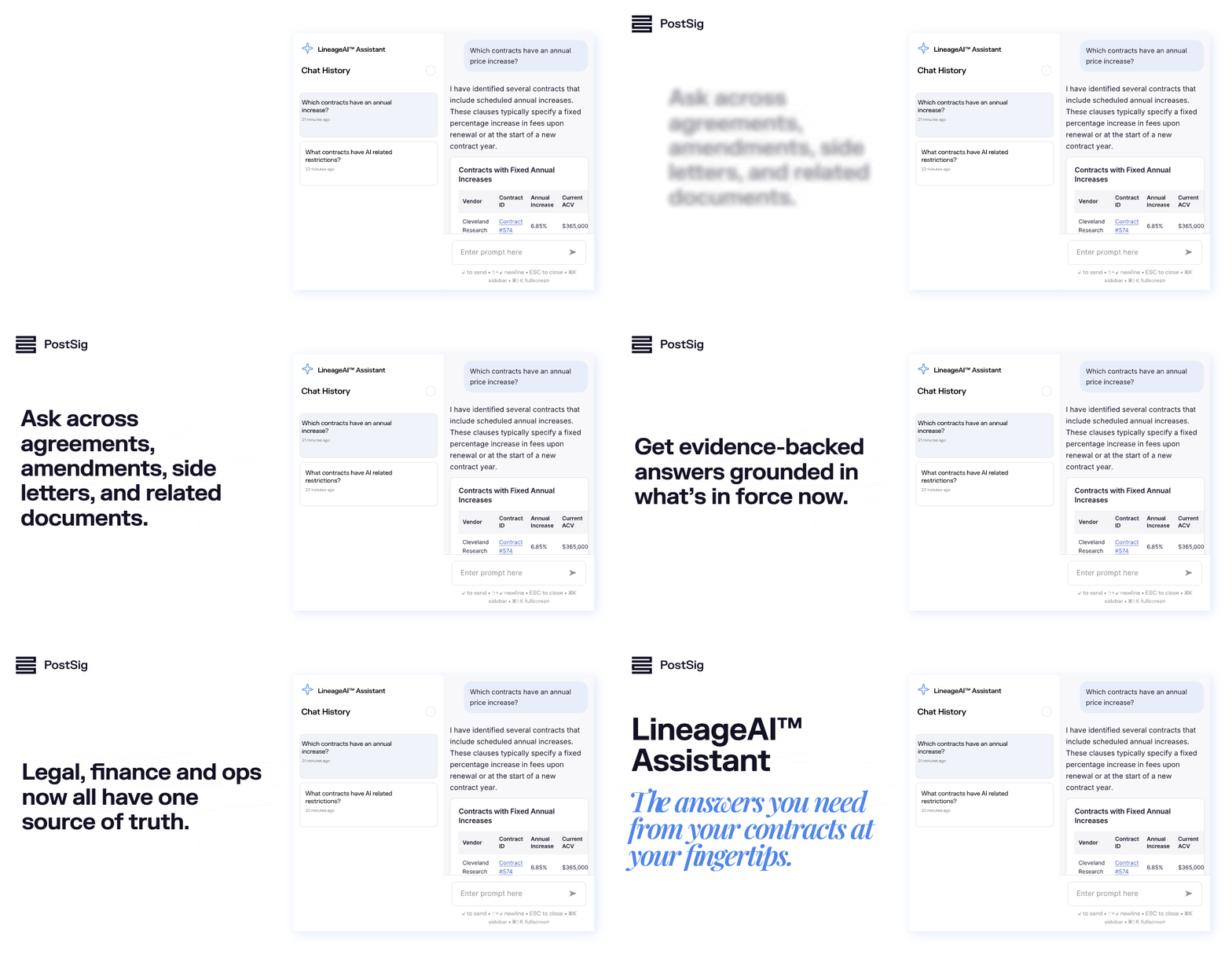
On top of that, PostSig’s LIneageAI Assistant makes getting the answers you need as simple as “Just Ask.” Teams can ask plain-language questions about renewal exposure, obligations, vendor terms, or what governs now and get evidence-backed answers grounded in the full document chain, not a single document in isolation. That means faster decisions, fewer blind spots, and no manual reconstruction across contracts, amendments, side letters, and related records.
This is the shift from document intelligence to decision intelligence.
Not just knowing what’s in a contract, but knowing what it means, what’s in force now, and what to do next.
Because every critical business outcome traces back to a contract. Revenue, cost, risk, compliance, and vendor performance are all governed by what was agreed.
The difference is whether your organization treats contracts as static records, or as a system that actively drives execution.
The leaders are making that shift. They are turning contracts into a real-time intelligence layer that connects intent to execution and becomes a source of truth for decisions.
What to do next
If your organization has already invested in CLM, ERP, or CRM systems but still lacks visibility after signature, you are not behind. You are at the inflection point the market is now recognizing.
The next step is not replacing those systems. It is connecting them.
You need a layer that sits above systems of record and continuously links contract terms to what is actually happening across your business.
That is what Contract Performance Management delivers.
Move beyond managing the lifecycle.
Start managing performance.
Because the real risk is not what is written in your contracts.
It is how far your business has drifted from them.
The companies that win will not be the ones that sign better agreements.
They will be the ones that ensure those agreements stay true in execution.