What Capital Markets Firms Get Wrong About Building Contract Intelligence In-House
AI tools make it easy to prototype contract intelligence. But once an internal tool becomes software the firm depends on, the real question is whether it can stay accurate, secure, supported, and cost-effective as contracts, vendors, invoices, and usage change.
Most firms do not wake up thinking they need contract intelligence.
They notice something more immediate.
An invoice looks wrong. A renewal window is approaching. A market data vendor asks about usage rights. Finance wants committed spend. Compliance wants evidence. Operations wants to know who owns the vendor.
So the internal question becomes obvious: could we build something ourselves?
With today’s AI tools, a team can prototype fast. A renewal dashboard. An invoice checker. A clause summary workflow. A usage tracker. Contracts go in. Key terms come out. A dashboard appears.
But once that tool supports spend control, renewal decisions, market data entitlements, invoice review, vendor negotiations, or audit evidence, it is no longer a prototype.
It is software the firm depends on.
That is where the economics change. The question is not “Can we build it?” It is “Can we keep it accurate, secure, explainable, supported, and trusted as contracts, invoices, vendors, amendments, usage rights, and renewals change?”
Before building contract intelligence in-house, capital markets firms should pressure-test five questions.
Five Questions Capital Markets Firms Should Ask Before Building Contract Intelligence In-House
1. Can every recommendation be tied back to the governing agreement?
Contract intelligence cannot stop at an answer. The firm needs to know why the answer is correct.
If the system says an invoice is wrong, which agreement supports that? Which service order? Which amendment? Which pricing schedule? Which billing term? If it says data can be redistributed, used externally, included in derived works, or applied to a specific workflow, where does that permission come from?
If it flags a renewal risk, which cancel-by date applies? Was that date changed by an amendment? Does the renewal term differ by product, vendor, business group, or service order?
A generic summary is not enough.
The output needs lineage, a traceable chain back to the specific documents, clauses, cross-document relationships, and amendments that support each answer.
Without lineage, finance, procurement, market data, legal, and compliance teams still have to manually reconstruct the evidence before acting. That means the internal tool is not replacing the old workflow. It is adding another step.
2. Did the business case include the people and AI costs required to keep it trusted?
The cost of an internal AI tool is not just the model, the seat license, or the first sprint. Once the tool matters, the cost expands into people, process, governance, and ongoing AI usage.
Someone has to maintain prompts, monitor outputs, review exceptions, manage access, update contract logic, respond to user questions, handle security reviews, and validate that answers are still accurate as documents and models change.
That work does not happen for free. It shows up in salaries, internal queues, delayed projects, legal review, compliance review, engineering time, and operational support.
Then there are the AI costs themselves. Usage-based pricing can be hard to forecast. New tools get added. Teams experiment. AI usage increases as more contracts, invoices, vendors, products, users, and workflows are added. What started as a low-cost prototype can become another source of budget uncertainty.
That does not mean building was the wrong decision. But it does mean the firm needs to ask a harder question:
Are we saving money, or are we moving the cost into engineering, operations, procurement, legal, compliance, and AI usage?
For a CFO or COO, the cost question is not only whether the tool can be built. It is whether the firm can support it without creating another hidden operating burden.
3. Can it catch invoice and billing issues before cash leaves the firm?
A vendor invoice is not just a payment request. It is a test of whether the firm can connect spend back to what was negotiated.
Can the internal tool compare invoices against the current governing agreement?
Can it account for amendments, service orders, product changes, billing frequency, discounts, annual increases, and contract value?
Can it flag unauthorized line items before payment is released?
Can it show whether a billed product, license, or service matches what the firm actually contracted for?
This is where a prototype can become risky. A dashboard may show that a contract exists, but finance needs to know whether the amount being paid is justified by the agreement in force now.
Once cash leaves the firm, the leverage changes. Recovery takes time. Credits can be delayed. Vendors may dispute the issue. Internal teams may have to reconstruct the record after the fact.
The better question is whether contract intelligence can help teams catch the issue before money moves.
4. Can it keep up as vendor terms, products, and usage rights change?
Vendor relationships do not stay static. A service order may add products. An amendment may change pricing. A renewal notice may shift timing. A usage schedule may define who can access a feed. A vendor policy may affect delivery or distribution. An invoice may reflect a term that no longer applies.
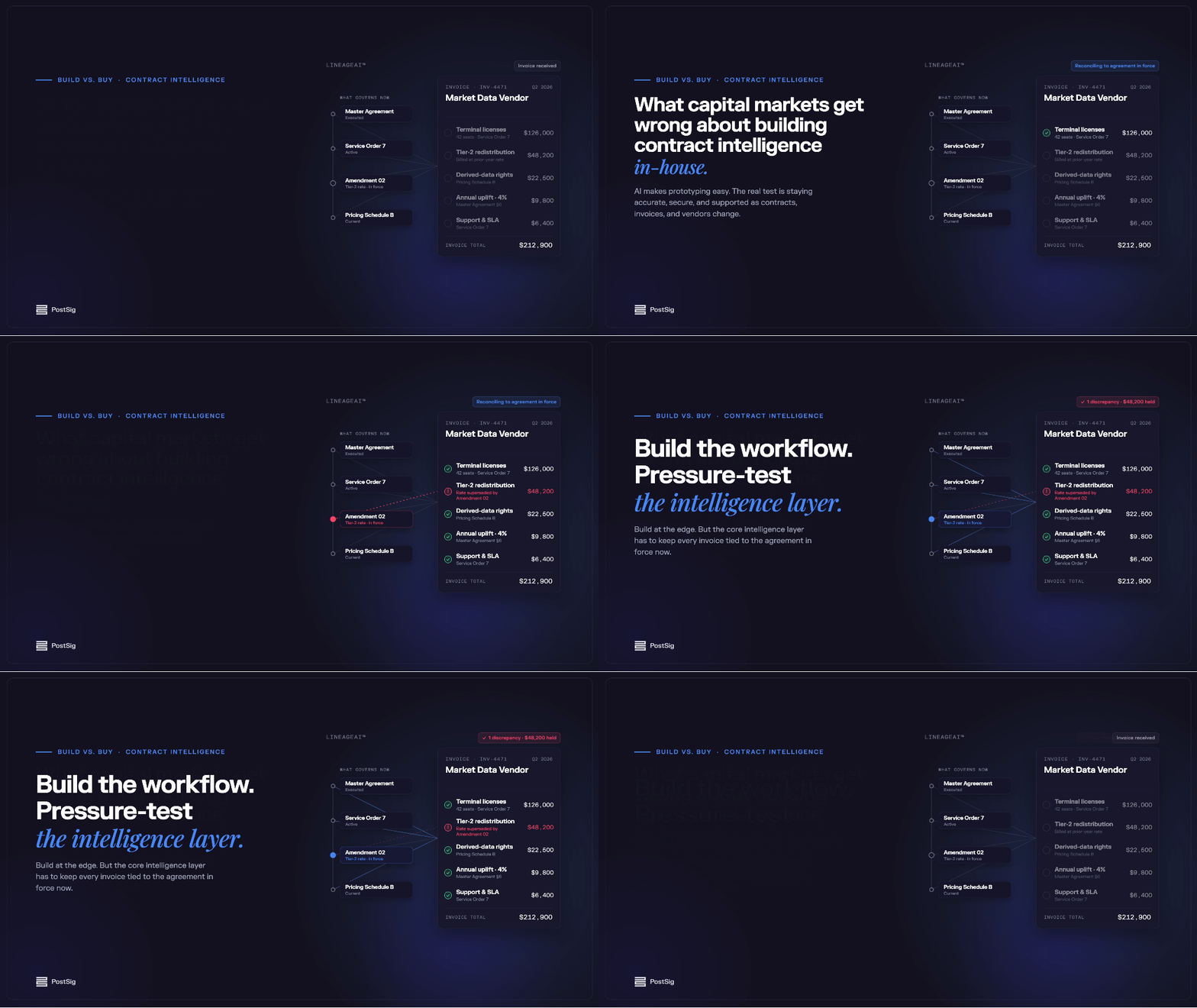
A one-time extraction captures what a document said at a moment in time. The firm needs to know what governs now.
That requires more than document search. It requires cross-document intelligence (the ability to follow how rights and obligations evolve across multiple documents rather than reading each in isolation) to follow how rights and obligations evolve across amendments, service orders, and invoices, not just within a single document–that can follow how contracts, amendments, invoices, entitlements, products, and usage restrictions evolve as the vendor relationship changes.
This gets harder as the contract stack grows. One clean vendor record may work in a prototype. The real test is whether the system still works across multiple agreements, service orders, amendments, invoices, products, regions, business groups, and usage constraints.
The question is not whether the system can summarize a document. The question is whether it can maintain a current view of cost, rights, obligations, renewals, and compliance constraints as the facts change.
5. What decisions will the firm make from this system once people rely on it?
This is the question that matters most.
A prototype is low-risk when everyone treats it as a draft. The risk changes when teams start relying on it.
Finance may use it before approving invoices. Procurement may use it before a renewal negotiation. Market data teams may use it to validate entitlements. Compliance may use it for audit evidence. Legal may use it to interpret usage restrictions. Leadership may use it to understand vendor exposure and forecast spend.
At that point, accuracy, lineage, permissions, and explainability are no longer nice to have.
They are the product.
The internal tool is no longer just helping someone work faster. It is shaping payment decisions, vendor conversations, compliance reviews, budget planning, and operational control.
That is when the firm needs to know whether the system is truly ready to be trusted.
The questions you do not ask can become the risks you inherit
These five questions are only the start.
A complete build-vs-buy decision has to account for the true operating burden behind an internal contract intelligence tool, including AI processing and usage-based fees, employee time, security review, access controls, invoice reconciliation, renewal tracking, entitlement and usage validation, compliance evidence, prompt and model monitoring, documentation, user support, and ongoing accuracy checks.
Those costs may not appear as one clean vendor line item. They show up across salaries, internal queues, delayed projects, payment reviews, legal escalations, compliance checks, support requests, and unpredictable AI usage.
That is what makes DIY contract intelligence hard to evaluate. The first build can look inexpensive because the visible cost is low. The real cost appears when the system becomes important enough for the firm to trust.
The real question is not “Can we build it?”
It is “Can we sustain it when the business depends on it, after accounting for AI usage, maintenance, support, security, and quality control?”
Build the workflow. Pressure-test the intelligence layer.
Capital markets firms may want to build internal reports, automations, dashboards, or AI-enabled workflows that reflect how their teams operate. That makes sense.
But the intelligence layer is different. It keeps contracts, amendments, invoices, entitlements, renewals, usage rights, obligations, and compliance evidence continuously connected as vendor relationships evolve, so teams can see what is in effect now and trace every answer back to its source.
Before deciding what to build, firms should separate two questions:
What workflows are unique to how our team operates?
And:
What intelligence must stay accurate, current, secure, explainable, and trusted over time?
That distinction is the heart of the build-vs-buy decision.
A firm may build at the edge. But the core intelligence layer has to keep answering the questions that matter after signature:
What did we buy?
What are we allowed to do with it?
Who can use it?
What are we being billed for?
Does the invoice match the agreement?
When do we need to act before renewal?
What obligations or restrictions apply?
What evidence supports our position?
This is what the full Decision Brief helps teams pressure-test.
Get the full 10-question checklist
These five questions are only the start.
Access The Build vs. Buy Decision: Before You Build Contract Intelligence In-House to see the full 10-question checklist and a practical framework for deciding what to build internally, what to buy, and how to evaluate the true cost of sustaining contract intelligence over time.