Before You Build Investor Rights Intelligence In-House
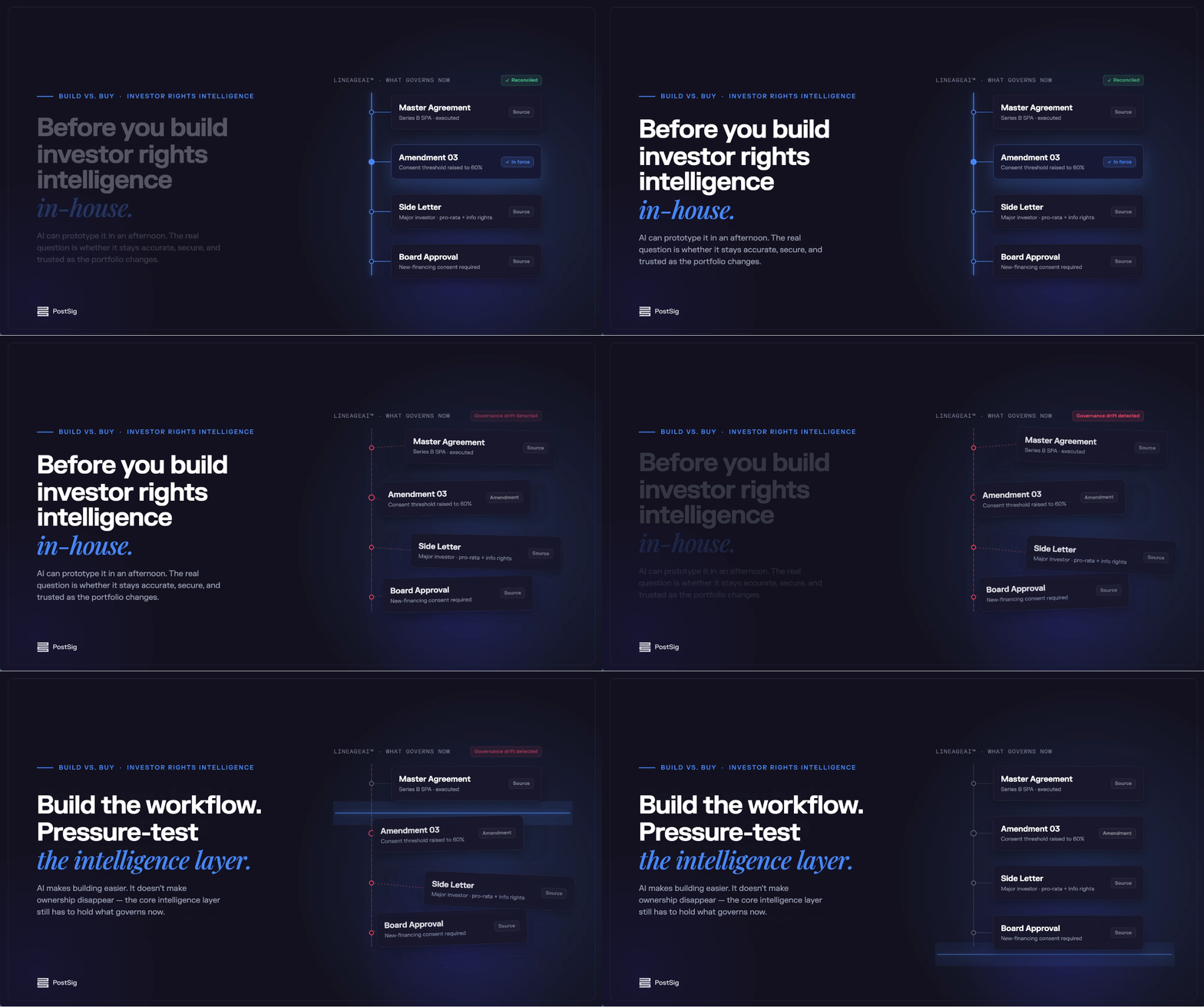
AI can help VC firms prototype faster. But once an internal tool becomes software the firm depends on, the real question is whether it can stay accurate, secure, supported, and cost-effective as portfolios change.
AI is changing how venture firms operate. Many firms are becoming more sophisticated about internal tooling, using AI to support portfolio operations, vendor management, fund workflows, diligence, reporting, and document review.
That progress is real. Venture teams move quickly, manage growing portfolios, and need better ways to turn fragmented information into answers. So when a firm looks at investor rights and thinks, “Could we build something ourselves?” the instinct makes sense.
With today’s AI tools, a team can prototype an investor rights tracker, approval dashboard, clause summary workflow, or portfolio document search tool faster than ever. Deal documents go in. Key terms come out. A dashboard appears.
The first version may look useful.
But at that point, the firm has not just built a workflow. It has started building software.
And software has to be maintained.
That means AI processing and usage-based fees, security review, access controls, QA, documentation, model monitoring, user support, and the people required to keep the system accurate. Model monitoring matters because AI outputs still need to be validated as documents, workflows, and models change.
The visible cost may look like the AI tool. The real cost is the operating model around it: salaries, support, security, quality control, documentation, and the ongoing work required to keep the system trusted.
The question quickly shifts from:
Can we build it?
to:
Did we actually save money once we account for what it takes to keep it trusted?
Investor rights intelligence is not a prototype problem. The harder question is whether the system can stay accurate, current, secure, explainable, and trusted as portfolios change.
Side letters get signed. Amendments modify prior terms. Financing rounds shift ownership. Board approvals create new records. LP reporting, valuation reviews, diligence requests, and audits all require evidence. A one-time extraction may help a team move faster at first, but it cannot become the firm’s source of truth unless it can keep up with that change.
AI makes building easier.
It does not make ownership disappear.
The first version proves feasibility. The operating layer proves whether the system can be trusted when the firm depends on it. And that is where the economics change.
The prototype may look inexpensive. But once the tool becomes part of how the firm manages rights, approvals, reporting, diligence, and governance, the cost is no longer just AI usage. It is maintenance, support, security, QA, and the people required to keep the system reliable.
The hidden risks are losing control, leverage, profit, and confidence
VC firms negotiate hard for rights at entry: board seats, consent rights, information rights, participation rights, protective provisions, major investor status, pro-rata rights, and liquidation preferences.
Then the portfolio moves.
New rounds happen. Convertible notes trigger. Cap tables evolve. Side letters matter. Prior terms are amended or restated. What was clear at closing becomes harder to reconstruct later.
That is governance drift.
Drift is the gap between what was agreed and what actually happens. In venture capital, it can show up when consent rights are missed, side letters are forgotten, approval thresholds are misread, governance constraints surface late, or portfolio actions move forward without full context.
The consequence is not just administrative cleanup. A missed consent right can weaken control in a financing. A forgotten side letter can create an avoidable legal escalation. A misread approval threshold can delay a board action or force a decision back through legal.
The economic impact can be just as real. An incomplete view of ownership economics can affect valuation support, LP reporting, or exit planning. A missed pro-rata right, participation right, or liquidation preference detail can create consequences that are not easy to unwind after the fact.
By the time the issue is discovered, the firm may have already lost time, leverage, confidence, or economic upside.
That does not mean VC firms should not build. It means they should pressure-test the build decision before an internal prototype becomes business-critical infrastructure.
Five Questions VC firms should ask before building investor rights intelligence in-house
1. Can it prove its accuracy?
Investor rights intelligence cannot stop at an answer.
The firm needs to know why the answer is correct.
If the system says consent is required, which document says that? Which clause? Was it modified by a side letter or amendment? Is that term still in force? Does it apply to this fund, this investor, this portfolio company, and this action?
A generic summary is not enough.
The output needs lineage, a traceable chain back to the specific document, clause, or side letter that supports each answer.
Without lineage, teams still have to manually reconstruct the evidence before making decisions. That means the internal tool is not replacing the old workflow. It is adding another step.
2. Can you see the full cost of ownership?
The cost of an internal AI tool is not just the model, the seat license, or the first sprint.
Once the tool matters, the cost expands.
Someone has to maintain prompts, monitor outputs, review exceptions, manage access, update document logic, respond to user questions, handle security reviews, and validate that answers are still accurate as documents and models change.
Then there are the AI costs themselves.
Usage-based pricing can be hard to forecast. New tools get added. Teams experiment. AI processing and usage-based fees increase as more documents, users, and workflows are added. What started as a low-cost prototype can become another source of budget uncertainty.
That does not mean building was the wrong decision.
But it does mean the firm needs to ask a harder question:
Are we saving money, or are we moving the cost into engineering, operations, legal, and AI usage?
3. Can it be trusted over time?
The first version may come from a technical partner, operating partner, analyst, legal ops lead, or internal AI champion.
For it to become useful, it first needs to be trusted.
For it to stay trusted, it needs to remain accurate, current, secure, and working correctly as the portfolio changes.
That requires dedicated resources.
It is never build it and forget it.
Someone has to manage document ingestion, QA, access controls, exception handling, user feedback, model changes, workflow changes, documentation, and ongoing validation.
If maintenance is not someone’s real job, the tool will compete with everyone’s real job.
That is when trust starts to erode.
Homegrown tools often become important enough to rely on, but not important enough to staff.
4. Can it determine what governs now?
Investor rights change over time.
A side letter may modify the standard agreement. A new financing may alter major investor status. An amendment may override a prior threshold. A board action may create new governance context. A capitalization update may affect ownership economics.
A one-time extraction captures what a document said at a moment in time.
A firm needs to know what governs now.
That requires more than document search. It requires cross-document intelligence (the ability to follow how rights and obligations evolve across multiple documents — amendments, service orders, side letters) rather than reading each in isolation. that can follow how rights, approvals, ownership economics, and governance constraints evolve as the portfolio changes.
This gets harder as the portfolio scales.
One clean company record may work in a prototype. The real test is whether the system still works across multiple funds, entities, rounds, side letters, document versions, and reporting needs.
The question is not whether the system can summarize a document.
The question is whether it can maintain a current view of rights, approvals, ownership economics, and governance constraints as the facts change.
5. What happens when people start depending on it?
This is the question that matters most.
A prototype is low-risk when everyone treats it as a draft.
The risk changes when people start relying on it.
When an investment team uses it before a financing decision.
When fund operations uses it for LP reporting.
When legal uses it to triage approvals.
When finance uses it for valuation support.
When leadership uses it to understand portfolio exposure.
At that point, accuracy, lineage, permissions, and explainability are no longer nice to have.
They are the product.
The questions you do not ask can become the risks you inherit
These five questions are only the start. A complete build-vs-buy decision has to account for the true operating burden behind an internal tool, including:
- AI processing and usage-based fees
- Employee time
- Security review
- Access controls
- QA and validation
- Exception handling
- Prompt and model monitoring
- Documentation
- User support
- Ongoing accuracy checks
- Auditability, including the ability to produce documented, traceable evidence of how a decision was reached for LP audits, regulatory review, or legal scrutiny
Those costs may not appear as one clean vendor line item. They show up across salaries, internal queues, delayed projects, legal review, support requests, and unpredictable AI usage. That is what makes DIY contract intelligence hard to evaluate.
The first build can look inexpensive because the visible cost is low.
The real cost appears when the system becomes important enough for the firm to trust.
At that point, the question is no longer just:
Can we build it?
It is:
Can we sustain it when the business depends on it, after accounting for AI usage, maintenance, support, security, and quality control?
Build the workflow. Pressure-test the intelligence layer.
VC firms may want to build internal reports, automations, dashboards, or AI-enabled workflows that reflect how their teams operate. That makes sense.
But the intelligence layer is different. It has to keep rights, approvals, ownership economics, governance constraints, and supporting documents continuously connected as the portfolio evolves.
Before deciding what to build, firms should separate two questions:
- What workflows are unique to how our team operates?
- What intelligence must stay accurate, current, secure, explainable, and trusted over time?
That distinction is the heart of the build-vs-buy decision.
A firm may build at the edge. But the core intelligence layer still has to answer the questions that matter after closing:
- What do we own?
- What rights do we have?
- What approvals are required?
- What changed across the document set?
- What evidence supports the firm’s position?
- What needs attention before a decision moves forward?
This is what the full Decision Brief helps teams pressure-test.
Get the full 10-question checklist
These five questions are only the start.
Access The Build vs. Buy Decision Brief: Before You Build Contract Intelligence In-House to see the full 10-question checklist and a practical framework for deciding what to build internally, what to buy, and how to evaluate the true cost of sustaining contract intelligence over time.