The Future of Market Data Won’t Be Built with Yesterday’s Architecture
Reflections on FISD’s recent whitepaper, Accelerating Peak Performance in Your Market Data Teams.
The most interesting thing about FISD’s Whitepaper on “Accelerating Peak Performance in Your Market Data Teams” isn’t what it says. It’s what it doesn’t say.
Jag Sidhu, Head of Market Data at Investec Bank Plc, and Sainath Chinnaswamy from the Data Governance & Big Data Center at the International Monetary Fund have written an excellent paper on the evolution of Market Data organizations. Their central argument, that Market Data must evolve beyond procurement and compliance to become a strategic partner to the business, is one I agree with almost entirely. Their emphasis on transparency, innovation, and closer alignment with the front office accurately reflects the direction many leading firms are already taking.
What struck me while reading the paper was not its recommendations, but the underlying assumption on which they are built. Throughout the paper, the future is presented as an evolution of today’s operating model. Better governance, stronger reporting, improved administration, and tighter integration all make sense, but they are layered onto an operating model that has remained largely unchanged for decades.
That assumption is worth challenging.
The market data industry has invested heavily in systems that record information exceptionally well. We know where contracts are stored, which users consume which services, how much is being spent, and which invoices belong to which vendors. Those platforms remain essential and will continue to underpin market data operations for years to come. What they were never designed to do, however, is understand the information they contain.
Artificial intelligence changes that equation.
For years, every significant business initiative has followed a familiar pattern. A new trading strategy, a research project, or more recently an AI initiative raises questions about licensing, permitted use, commercial terms, or governance. The Market Data team reviews contracts, checks entitlements, reconciles commercial terms, searches email, and where necessary engages vendors or exchanges before providing guidance. That workflow has become deeply embedded in most financial institutions because it reflects the capabilities of the technology available at the time.
Today, the technology has changed, but the operating model largely hasn’t.
The opportunity presented by AI is not simply to make that process faster. It is to redesign it.
Instead of relying on a small team to answer an ever-growing queue of questions, organizations should be asking how those questions can be answered safely by the business itself. Portfolio managers should understand whether a dataset supports an internal AI initiative without waiting for a manual review. Market Structure teams designing new trading systems should know which datasets are already licensed before writing a line of code. Procurement should have immediate visibility into renewal exposure. Legal should be able to identify restrictive licensing language within seconds, while Finance should reconcile invoices against negotiated commercial terms automatically. Some situations, particularly those involving exchange licensing where AI policies continue to evolve, will still require specialist expertise and direct engagement. Increasingly, however, those should become the exception rather than the rule.
This is where I believe the next generation of Market Data organizations will distinguish themselves.
The FISD paper argues that Market Data should become more strategic, and I couldn’t agree more. My view is simply that strategy will be expressed differently. Rather than operating primarily as an internal service function, Market Data has the opportunity to become the steward of enterprise knowledge. Its role shifts from answering individual questions toward defining governance, negotiating commercial relationships, maintaining policy, and creating the trusted foundation that enables every other part of the organization to operate with confidence.
That evolution elevates the function far beyond administration. It transforms Market Data into an organization that enables the business rather than one that mediates it.
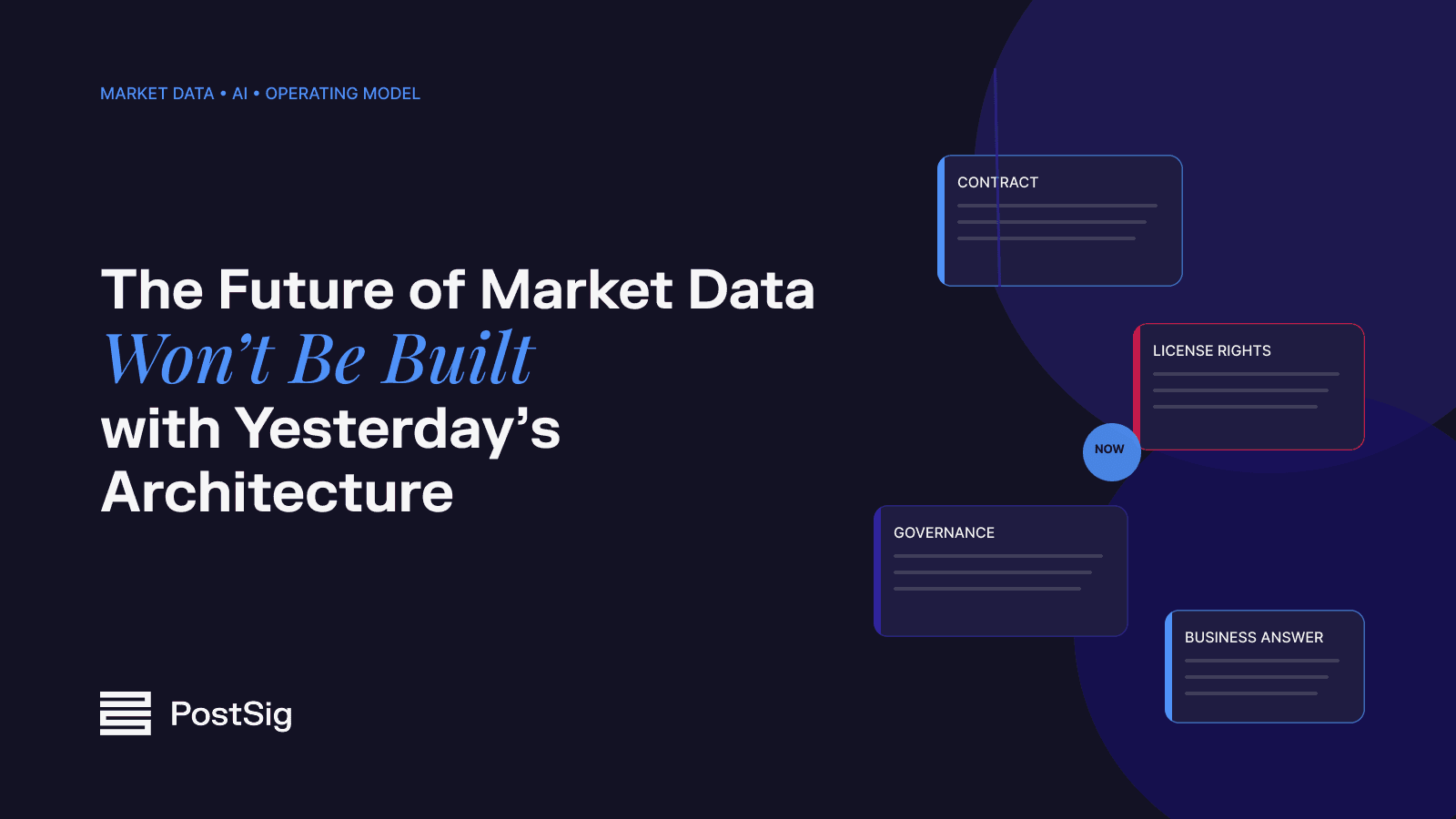
One recommendation in the paper particularly resonated with me. The authors encourage firms to automate contract parsing, invoice reconciliation, and other administrative workflows. That is exactly the right direction.I would simply extend that thinking one step further. The real opportunity begins when contracts, licensing rights, commercial obligations, governance policies, and data lineage become connected knowledge rather than isolated documents. At that point, AI is no longer automating individual tasks. It is helping organizations reason across the relationships between them.
For decades, Market Data leaders have been measured by how effectively they negotiated contracts, controlled spend, and maintained compliance. Those responsibilities will remain fundamental, but they will no longer define the function. The organizations that create the greatest value over the next decade will be those that enable every part of the business to make faster, better-informed decisions while remaining within well-defined commercial and governance boundaries.
FISD is right that Market Data is becoming more strategic.
The question I would leave the industry with is whether we should continue optimizing the operating model we’ve inherited or whether AI gives us the opportunity to design an entirely new one.