Your VC Portfolio Data Can Look Right and Still Be Wrong
Why portfolio data drift puts investor rights, ownership accuracy, and reporting at risk, even when everything looks correct.
Venture capital portfolio intelligence and investor rights platforms have a problem that people don't talk about enough.
The data can look complete, the dashboard can look clean, and the underlying answer can still be wrong.
We saw this firsthand after launching PostSig Investor Rights Intelligence™ (PostSig IRI™) and helping firms move their portfolio data off Aumni earlier this year. The migration gave us a chance to compare inherited data against the source documents underneath it.
The problem we found can happen in any system that stops reconciling structured portfolio data back to the agreements and events that govern it.
What we found
We reconciled the imported portfolio data against the underlying source documents. Across each new customer’s funds and portfolio companies, we consistently found at least one discrepancy in the records.
The issues were not rounding errors.
- One company showed 4% ownership against a 5% Major Investor threshold in the system, whereas source documents showed 10% ownership, meaning an active investor right was completely missed.
- Multiple active equity and debt positions were recorded at $0 cost basis or missing from active holdings despite having actual values ranging from several hundred thousand dollars to millions.
- A 1-for-20 reverse stock split post-IPO appeared in the structured data without supporting documentation, throwing off downstream share counts and ownership calculations.
- Portfolio entities appeared under the wrong fund vehicle, and share counts on internal schedules of investment differed from primary purchase agreements and closing documents.
- Complex exit structures, such as mergers with milestone earnouts, CVRs, asset sales, and stock conversions, had material discrepancies between recorded units and actual consideration received.
None of these was introduced during migration.
The data moved exactly as it existed in the previous system.
This is not really a migration problem.
A migration simply made the issue easier to see.
The same thing can happen in any investor rights or portfolio intelligence platform if the system treats the structured dataset as the authority instead of continuously checking it against the source documents.
That distinction matters because venture portfolios do not sit still.
A field that was once correct can later become wrong without anyone manually changing it.
Companies raise new rounds. Ownership changes. Stock splits happen. Side letters create additional rights. Amendments modify existing terms. New documents arrive, sometimes years after the original investment.
The problem was that the existing data itself had drifted from the evidence.
That is drift.
And it is especially difficult to catch because nothing necessarily looks broken. The company is still there. The percentage field still has a number in it. The system still returns an answer.
It may merely be an answer that stopped being true… without anyone noticing it.
We had to change our own thinking, too.
When we first brought portfolio data from other platforms into PostSig IRI, we treated the inherited dataset as a practical starting point. We thought it would be easier for our customers.
That made sense. Firms needed continuity, and rebuilding years of portfolio data manually would defeat the purpose of moving to a new system.
But as we brought on more customers and continued to enhance PostSig IRI, we started going back through the underlying source documents and rerunning them through our cross-document intelligence platform, LineageAI™.
That is when the pattern became clear.
A portfolio platform cannot merely ingest data once and assume the job is done.
If the system's value depends on ownership, investor rights, valuation data, approval thresholds, or governance terms, it must keep understanding how those answers change over time.
That is a much harder problem than extraction.
The problem with document-by-document intelligence
Most extraction, whether done by software or by people, works one document at a time.
That is useful, but it is not enough.
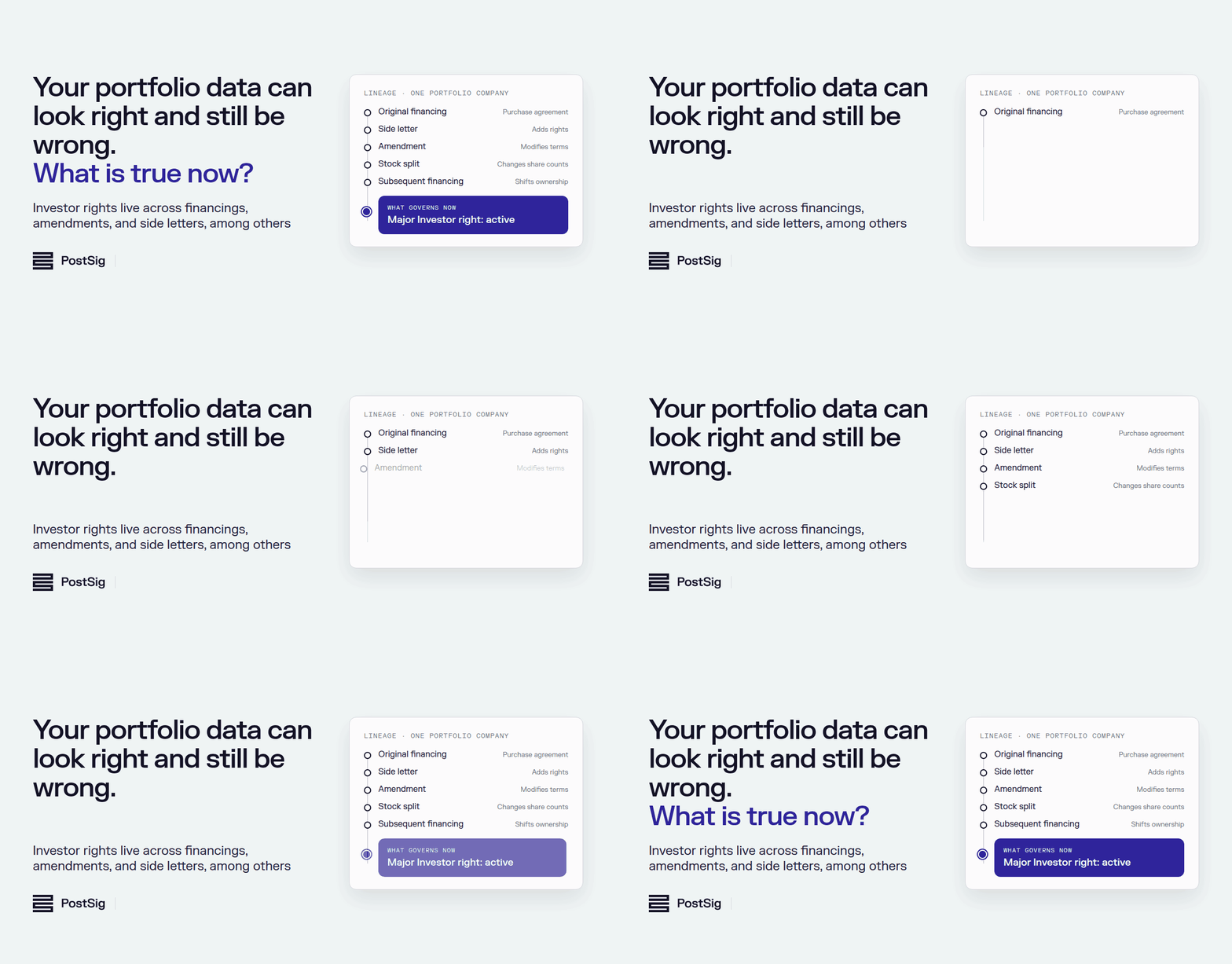
For example, investor rights rarely live neatly inside one agreement. The current answer to an investor rights question may depend on an original financing document, a later amendment, a side letter, a stock split, a subsequent financing, or an updated ownership record.
Reading any one of those documents correctly does not guarantee the system understands how they affect one another.
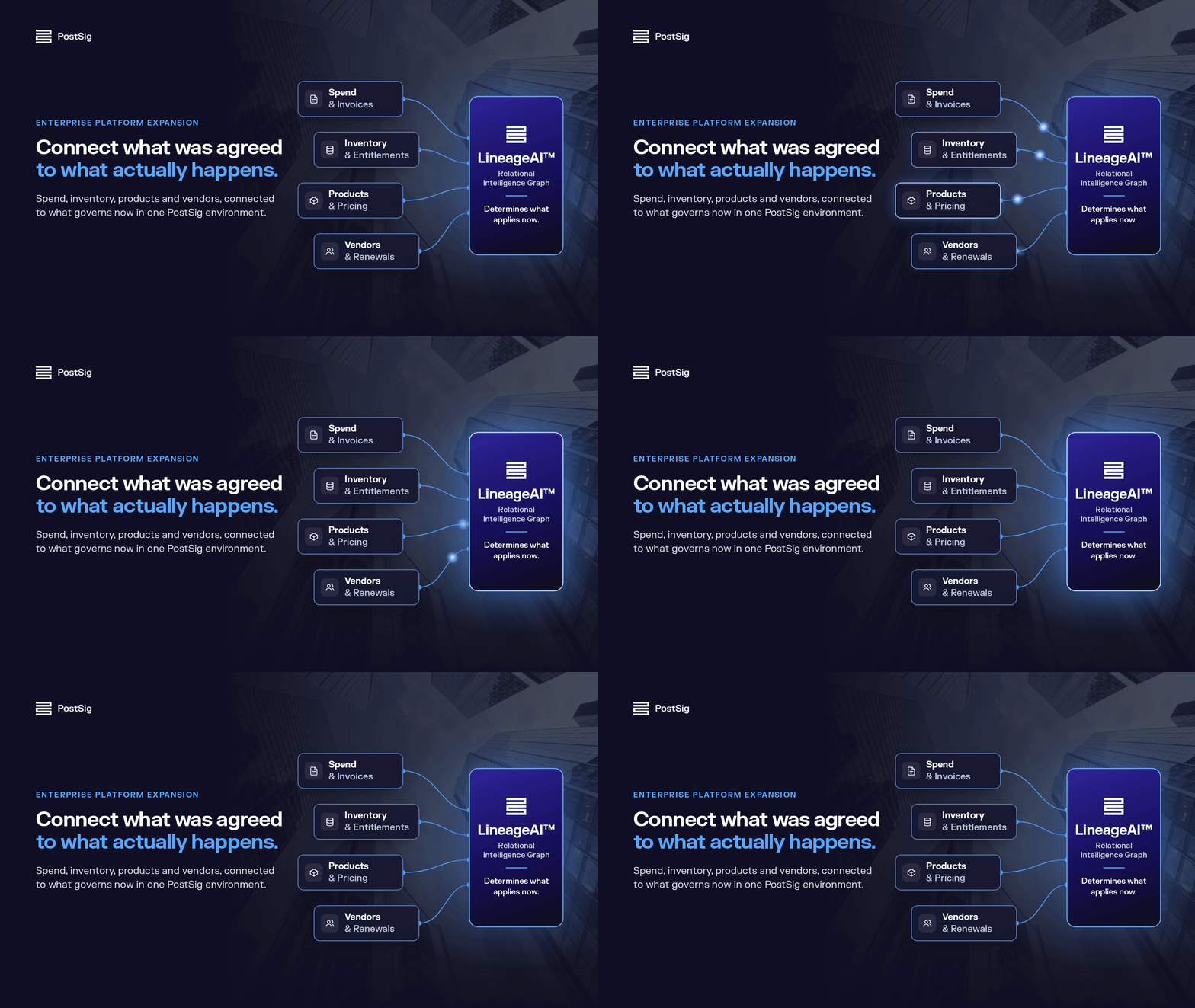
LineageAI, PostSig’s cross-document intelligence platform, connects related documents, traces how terms and facts change over time, and helps determine which information governs now.
That shift matters.
Instead of asking only, “What does this document say?” the system can ask, “Given everything that has happened since, what is true now?”
Why this matters across the category
This is why we do not think the next generation of investor rights intelligence will be defined by who has the nicest dashboard or who can extract the most fields.
Those things are becoming table stakes.
The harder and more important question is whether the system can maintain a continuously current understanding of the portfolio as documents, ownership, and rights change.
A static database cannot do that by itself.
A one-time extraction cannot do that.
A new interface cannot do that.
Moving the same underlying process to a new platform does not necessarily change the outcome.
If the system does not keep reconnecting the data to the evidence, drift eventually wins.
Investor rights are unforgiving.
This matters because small data errors can have very real consequences.
A stale ownership percentage can mean a missed Major Investor right.
An incorrect valuation can flow into reporting.
An unreflected stock split can distort the rest of the ownership picture.
A company tied to the wrong fund vehicle can create downstream governance and reporting problems.
None of these issues require a dramatic system failure.
They can happen quietly, while everything still appears to be working.
That is the part firms should be thinking about.
Not simply whether their investor rights platform has the data.
Whether the system can still prove that the data is right.
The question is bigger than where your data lives.
Many firms spent the first part of this year deciding where their portfolio data should live next.
That was a necessary question. It is not the most important one.
The better question is:
How does your system know the answer it is showing you is still true?
That is the problem we are building PostSig IRI around.
Not simply storing portfolio information. Not just extracting it again.
Connecting the underlying evidence, following how it changes, and maintaining a current view of what governs now.
Because the goal is not to preserve yesterday's dataset.
It is to know what is true today.
How does your investor rights platform know its data is still right?
See how PostSig IRI uses LineageAI to connect source documents, track changes over time, and determine what governs now. https://postsig.com/investor-rights-intelligence