Enterprise Software Should Not Dictate Your Operating Model
This is not a new dynamic.
Salesforce, Oracle, SAP, and many other enterprise platforms have built enormous consulting and implementation ecosystems around their products. These systems have become so complex that many customers cannot implement, configure, or operate them effectively without specialist support.
Managed service providers solve a genuine problem. They translate complex software into usable business outcomes.
The opportunity with AI is not to eliminate those providers. It is to change the relationship between the platform, the provider, and the customer.
A growing number of managed service providers use PostSig CPM to manage more clients, more efficiently, with greater confidence in the underlying data. At the same time, we are seeing independent teams choose PostSig because they want to retain control of their decisions, data, and workflows.
Both models are valid.
Some organizations want an expert partner to manage the process. Others have the expertise in-house and want the flexibility to build their own workflows. Many will combine internal ownership with specialist external support.
The problem starts when the technology and the service become inseparable.
It is like buying a great car and discovering that you are also required to hire the manufacturer’s driver. The arrangement may initially be convenient, but it limits who can operate the car, how it can be used, and how easily the owner can change direction.
Long managed service agreements can compound that dependency. Over time, the provider may control not only the software but also the data, workflows, operating knowledge, and history behind critical decisions.
Complex businesses need more than one perspective
Complex businesses cannot be understood through a single operating view.
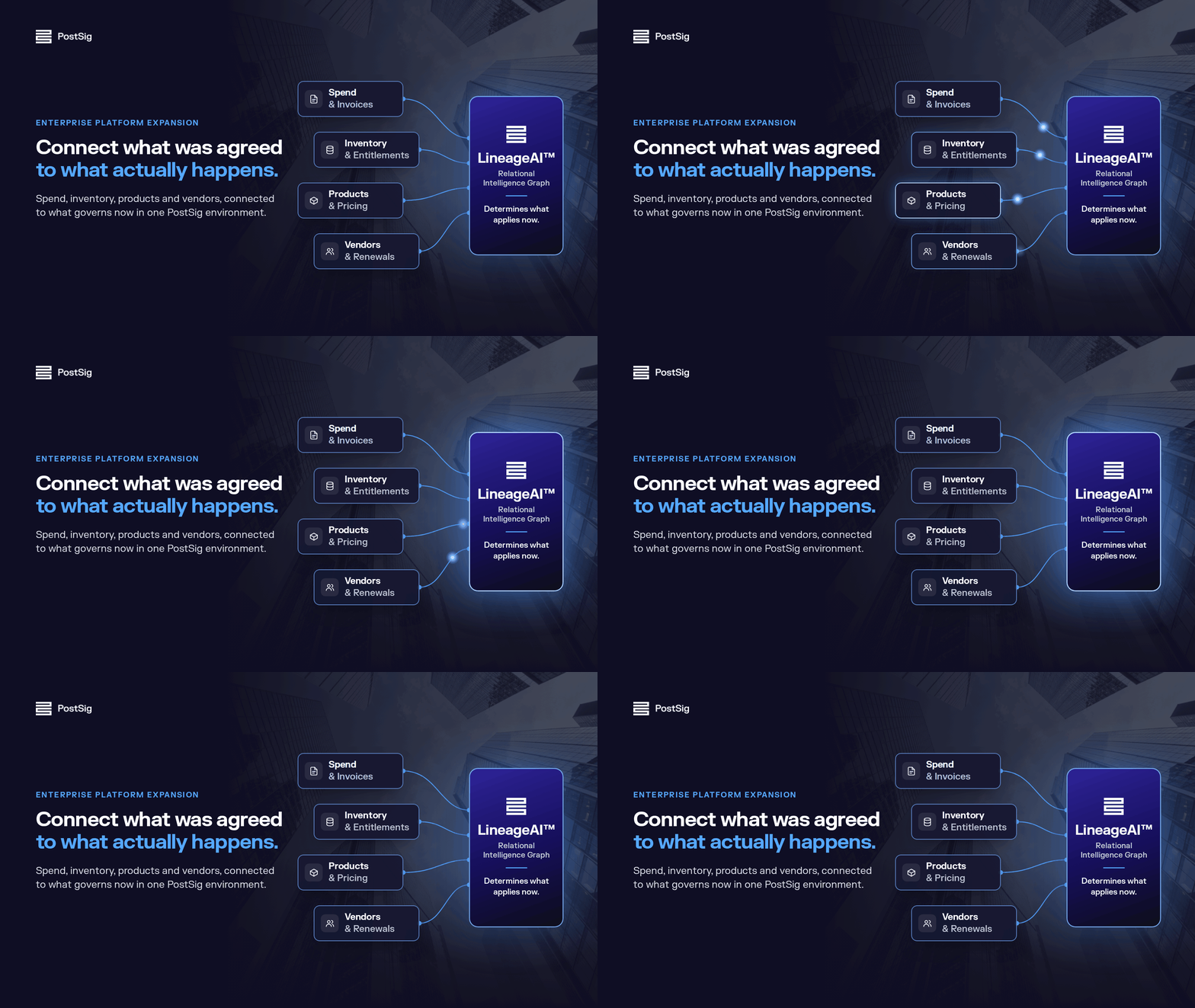
An executive may want to understand spend. An operating team may organize its work around vendors. A specialist may need product-level insight. Underneath everything, the organization needs a reliable inventory connecting the records.
These are not separate problems. They are different ways of understanding the same business reality:
● Spend-centric: The executive view of cost, exposure, and opportunity.
● Vendor-centric: The primary model for managing commercial relationships and performance.
● Product-centric: The specialist view of what is being purchased, used, and governed.
● Inventory-centric: The foundation connecting contracts, products, vendors, usage, obligations, and spend.
Traditional software often prioritizes one of these perspectives. Users then move between applications, reports, spreadsheets, and logins to answer different questions.
A knowledgeable managed service provider can make that experience easier. But the customer still depends on another organization for answers that should increasingly be available immediately.
AI changes the model
The best interface may not be another application. It may be where people already work, ask questions, collaborate, and make decisions.
That could be Google Gemini, ChatGPT, Claude, or an organization’s own applications and internal tools.
Meeting users where they work does not mean forcing customers or service providers to rebuild everything underneath. They should not have to recreate the data model, permissions, source evidence, integrations, and workflows every time they need a new report, question answered, or process automated.
The platform should provide that foundation.
Customers and their service providers can then focus on what users need:
● Reports and dashboards.
● Immediate answers to complex questions.
● Automated processes and exception handling.
● Different perspectives on the same trusted data.
● Self-service access for other business units.
● Workflows embedded into the tools people already use.
Instead of requiring five applications to produce five versions of an answer, the same underlying records should support the perspective each user needs.
Managed services should create leverage, not dependency
Managed service providers will continue to play an important role. Many complex operations require specialist knowledge, commercial judgment, and contextual understanding that software alone cannot yet provide.
The question is whether the technology gives those providers leverage or forces them to compensate for the limitations of the platform.
Good software should allow a managed service provider to serve more customers with greater efficiency and confidence. It should reduce repetitive work, improve data quality, and make recommendations traceable to their sources.
It should also preserve the customer’s independence.
Customers should be able to access their own records, understand how conclusions were reached, and retain ownership of their decisions and workflows. Changing service providers or bringing work in-house should not require replacing the underlying technology or reconstructing years of institutional knowledge.
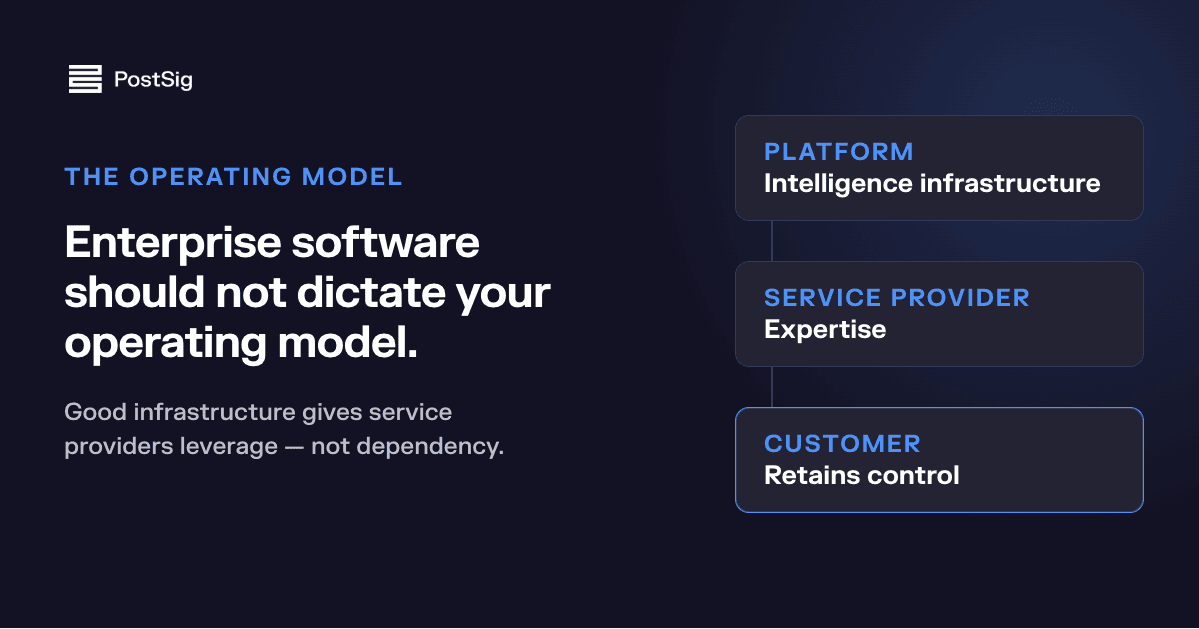
The service provider contributes expertise. The platform provides the shared foundation. The customer retains control.
That is the model behind PostSig CPM.
We enable managed service providers to scale their expertise while giving customers the freedom to operate independently, work with the provider of their choice, or combine internal ownership with external support.
AI should not make services obsolete. It should make expertise more scalable, answers more immediate, and customers more independent.
We are building that operating model alongside independent teams and managed service providers, not in place of them.